|
|
|
SHARK INFO |
|
SHARK |
|
SHARK EVOLUTION |
|
|
|
SHARK DIVING |
|
SHARK DIVING 101 |
|
|
|
CONSERVATION |
|
|
|
PHOTOGRAPHY |
|
SHARK PHOTO TIPS |
|
|
|
RESOURCES |
|
|
|
WEB STUFF |
|
WHAT IS ELASMODIVER? Not just a huge collection of Shark Pictures: Elasmodiver.com contains images of sharks, skates, rays, and a few chimaera's from around the world. Elasmodiver began as a simple web based shark field guide to help divers find the best places to encounter the different species of sharks and rays that live in shallow water but it has slowly evolved into a much larger project containing information on all aspects of shark diving and shark photography. There are now more than 10,000 shark pictures and sections on shark evolution, biology, and conservation. There is a large library of reviewed shark books, a constantly updated shark taxonomy page, a monster list of shark links, and deeper in the site there are numerous articles and stories about shark encounters. Elasmodiver is now so difficult to check for updates, that new information and pictures are listed on an Elasmodiver Updates Page that can be accessed here:
|
|
_ |
ATLANTIC DEVILRAY |
|
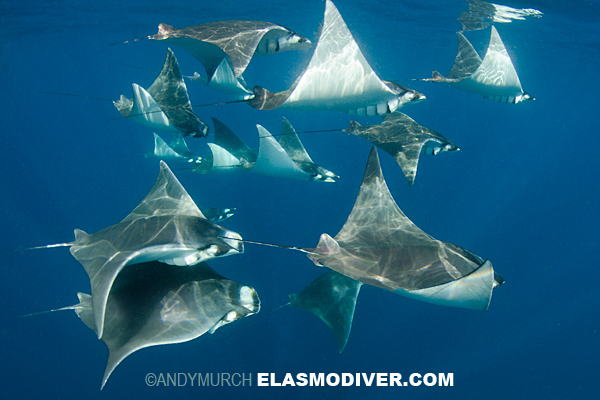
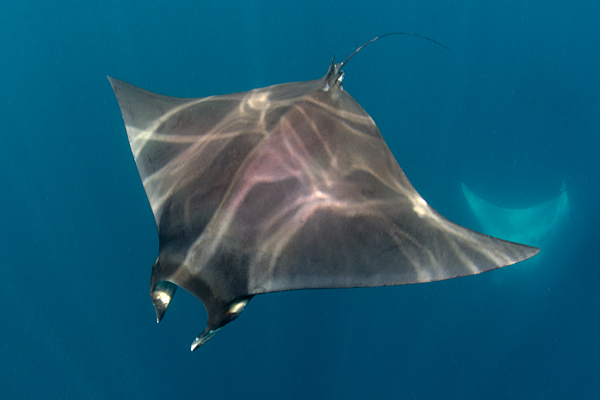
View all available Atlantic / Lesser Devilray Pictures in the shark picture database Atlantic devilray, lesser devil ray, Atlantic mobula ray, devil ray, small devilfish, manta ray. Latin Name: Mobula hypostoma Synonyms: Cephalopterus hypostomus Family: Mobulidae
Other Names:
Identification: Dorsum black or very dark brown. No tail spines. Base of tail laterally compressed. Relatively short cephalic lobes and long caudal filament (tail) compared to other mobulids. Pale spot near free tip of dorsal fin.
Size: Maximum disc width 120cm. Size at birth 55cm
Habitat: Shallow inshore waters. From surface to sea floor.
Abundance and distribution: The Atlantic devilray is restricted to the Western Atlantic from New Jersey in the north to Santos, Brazil in the south including the Gulf of Mexico. Possibly also present in the Azores.
Diet: The Atlantic mobula feeds mostly of planktonic crustaceans (mysid shrimp) but will also consume very small fishes.
Reproduction: Ovoviviparous with one pup per lItter. Atlantic devilrays reportedly swim venter to venter towards the surface while mating.
Vulnerability: The Atlantic devilray is assessed as 'data deficient' by the IUCN. IUCN Quote: It [the Atlantic devilray] is taken as bycatch in longline, net and possibly other fisheries, but very little specific information is currently available on its capture, abundance and population trends from across its range. Although trawl survey data from the east coast of the USA suggests possible increasing trends there, this represents the northern extent of its range, and further information is required on its abundance and interaction with fisheries from the Caribbean Sea and South America. This species is therefore assessed as Data Deficient until population trends and the impact of fisheries can be determined.
Photographs: Gulf of Mexico near Panama City, USA.
Similar species: Mobula rays are very difficult to differentiate in the field. The Atlantic devilray shares its range with the sicklefin devil ray Mobula tarapacana which can be distinguished by its larger size, swept back pectoral fins, bluish to olive grey dorsum and ventral markings which are pale anterially and dark posterially with a distinct demarcation between the two shades. Other mobulas have not been confirmed from the western Atlantic but some may be cicumtropical.
Reaction to divers: Devil rays do not usually allow divers to get close especially if they are producing noisy scuba bubbles. Patience and some skill at breath holding may produce better results.
Diving logistics: In the Pan Handle of Florida (Northern Gulf of Mexico) it may be possible to encounter Atlantic devilrays while snorkeling off of the beaches. The images shown here were taken during a jetty dive in Panama City in July. Mobulas often migrate into warmer water in the winter so the best time to look for them in their northern range is probably in mid to late summer.
Encounters reported by divers:
Further reading: http://www.fishbase.org/ http://www.iucnredlist.org/ |
|
|
|
SHARK TRIPS |
 |
 |
 |
 |
 |
 |
 |
 |
|
MORE EXPEDITIONS |
 |
 |
 |
 |
 |
 |
 |
 |
 |
 |
 |
 |
|
|
|
SPONSORS |
 |
 |
|
ADVERTISERS |
|
|


|
|
|
ELASMO-BLOGS |
 |
 |
 |
 |
 |