Shark Pictures   

Shark & Ray Field Guide   

   shark diving and whale diving and humboldt squid encounters 


HOME

THE FIELD GUIDE

SHARK PICTURES

WHAT'S NEW?

SHARK BLOG

MERCHANDISE

SHARK TRIPS

SITE MAP

E-MAIL


EXPEDITIONS
Humboldt squid diving and diving with sperm whales and fin whales.
Oceanic Whitetip Diving at Cat Island, Bahamas.


SHARK & RAY FIELD GUIDE

SHARK PICTURES

DAILY SHARK PIC

BUY PRINTS

BASIC SHARK PHOTOGRAPHY

PHOTOGRAPHY WORKSHOPS

PROJECT DEEP SHARK

SHARK DIVING

SHARK DIVING EXPEDITIONS

SHARK DIVING 101

SHARK DIVING HOTSPOTS

DIVE OPERATOR DIRECTORY

SHARK DIVING STORIES

FEEDING SHARKS

SHARK ATTACKS

THE SHARK TOUR

CONSERVATION

SHARKS UNDER THREAT

PREDATORS IN PERIL

ACTIVISTS SAVING SHARKS

SHARK BIOLOGY

SHARK FACTS FOR KIDS

SHARK & RAY BIOLOGY

SHARK & RAY TAXONOMY

SHARK & RAY EVOLUTION

GLOSSARY OF TERMS

RESOURCES

SHARK NEWS

SHARK LINKS

SHARK BOOKS

SHARK MOVIES & DOCUMENTARIES

WEB STUFF

 ADVERTISE

CONTACT INFO

ABOUT ELASMODIVER

SHARK TALK

ELASMODIVER CONTRIBUTORS

BIO OF ANDY MURCH

 
 ELASMOBRANCHS

Not just Shark Pictures: Elasmodiver contains photos of sharks, skates, rays, and chimaera's from around the world. It began as a simple web based field guide to help divers find the best places to encounter different species of sharks and rays but it has slowly evolved into a much larger project containing information on all aspects of shark diving and photography. There are now more than a thousand shark pictures  and sections on shark evolution, biology, and conservation. There is a large library of reviewed shark books, a constantly outdated shark taxonomy page, a monster list of shark links, and deeper in the site there are numerous articles and stories about shark encounters. Elasmodiver is now so difficult to check for updates, that new information and pictures are listed on an Elasmodiver Updates Page that can be accessed here:

WHAT'S NEW?

Shark picture - green sawfish

_

SHARK FOOD?

ELASMODIVER EXPANDED

If you're looking for a broader range of marine life pictures the following links represent a new area of elasmodiver.com that contains pictures of other marine organisms and of marine habitats. This expansion of Elasmodiver is in its first stages but will eventually include pages on all types of marine mammals, bony fishes and marine invertebrates as well as coastal habitats, reefscapes and other imagess relating to the ocean. Please return regularly to enjoy the progress.


IMAGE PAGES

CRAB PICTURES
CROCODILEPICTURES
DOLPHIN PICTURES

FISH PICTURES

LOBSTER PICTURES

MARINE PICTURES

OCTOPUS PICTURES

SEALION PICTURES

SHARK PICTURES

SHELL PICTURES

SHRIMP PICTURES


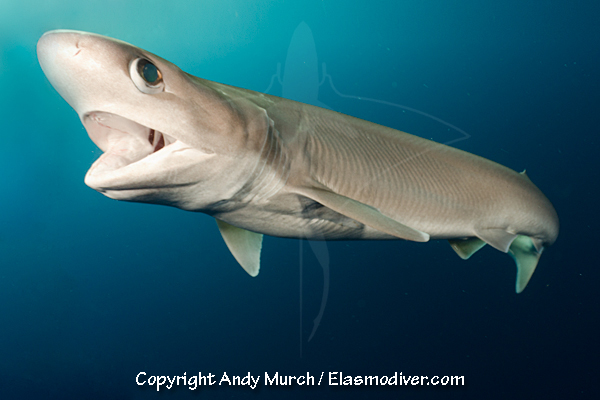
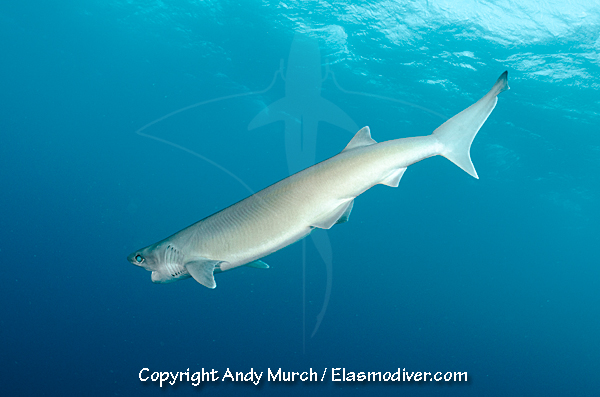
Bigeye Sixgill Shark

View all available Bigeye Sixgill Shark Pictures in the Shark Pictures Database

Common Names: Bigeye sixgill shark, Sixgill shark, bigeyed sixgill, cow shark.

Latin Name: Hexanchus nakamurai

Family: Hexanchidae  

Identification: Six gill slits. Sender body (compared to H.griseus). Single dorsal fin set well back above anal fin. Caudal fin with distinct lower lobe and deeply notched upper lobe. Large round pupils reflect a luminous green. Five rows of large comb shaped teeth.

Size: 180cm maximum. Size at birth 40-43cm.  

Habitat:  Temperate and tropical seas. Usually at great depth (90 to 620m). Long line collection in Cape Eleuthera by Edd Brooks (Cape Eleuthera Institute) indicates that bigeye sixgill sharks may inhabit greater depths than previously recorded.

Abundance and distribution: Found worldwide - Western Atlantic from Florida, Bahamas, Northern Caribbean, Atlantic Panama and Costa Rica and Venzuela to Northern Brazil. Eastern Atlantic from Southern Europe to North Africa including much of the Mediterranean Sea. Indian Ocean off of East Africa and Western Australia and in the Western Pacific from Japan and the Philippines and Eastern Australia. Not recorded in the Eastern Pacific. Distribution records are patchy because the bigeye sixgill shark is a rarely caught species. Many isolated pockets in this species' range may eventually be linked once more catch data becomes available.

Red List Status: Data deficient. Sometimes taken as bi-catch in line fisheries and as part of the artisanal shark fishery in the Gulf of Mexico.

Diet:  Small to medium sized bony fishes and crustaceans.  

Reproduction: Ovoviviparous. 13-26 pups per litter.

Photographs: Cape Eleuthera, Bahamas. Photographed during a tagging study conducted by Edd Brooks of the Cape Eleuthera Institute.

Similar species: Bluntnose sixgill Hexanchus griseus. The bluntnose sixgill shark can be identified by its generally larger size and stockier body, its indistinct lower caudal lobe and lack of a notch in the upper caudal lobe.

Reaction to divers: Not applicable however a captured specimen showed aggressive behavior when manhandled during release.

Diving logistics: Not applicable

References and further reading:

IUCN Red List of Endangered Species: http://www.iucnredlist.org/apps/redlist/details/161352/0

Cape Eleuthera Institute Shark Ecology Program http://www.ceibahamas.org/shark-ecology.aspx


HOME     LINKS     TAXONOMY      UNDER THREAT     BOOKS     CONTACT

 
EXPEDITIONS
Humpback whale diving and manta diving in Socorro.
Sharkfest Sandtiger Shark Diving
Tiger shark diving at Tiger Beach, Bahamas.
 
SPONSORS
 
ADVERTISERS

 
ELASMO-BLOGS


shark diving and photography expeditions


IF YOU LIKE THIS PAGE PLEASE SHARE IT Share


SharkPictures   Shark & Ray Field Guide   SharkPhotography   SharkDiving   Taxonomy   Evolution   Biology   SharkAttacks   Books   Shark Movies   Stories   Extinction   Protection   Updates   SiteMap


CONTACT ELASMODIVER

elasmodiver@gmail.com

250-588-8267

P.O.Box 8719 Station Central, Victoria, BC., V8W 3S3, Canada