|
|
|
SHARK INFO |
|
SHARK |
|
SHARK EVOLUTION |
|
|
|
SHARK DIVING |
|
SHARK DIVING 101 |
|
|
|
CONSERVATION |
|
|
|
PHOTOGRAPHY |
|
SHARK PHOTO TIPS |
|
|
|
RESOURCES |
|
|
|
WEB STUFF |
|
WHAT IS ELASMODIVER? Not just a huge collection of Shark Pictures: Elasmodiver.com contains images of sharks, skates, rays, and a few chimaera's from around the world. Elasmodiver began as a simple web based shark field guide to help divers find the best places to encounter the different species of sharks and rays that live in shallow water but it has slowly evolved into a much larger project containing information on all aspects of shark diving and shark photography. There are now more than 10,000 shark pictures and sections on shark evolution, biology, and conservation. There is a large library of reviewed shark books, a constantly updated shark taxonomy page, a monster list of shark links, and deeper in the site there are numerous articles and stories about shark encounters. Elasmodiver is now so difficult to check for updates, that new information and pictures are listed on an Elasmodiver Updates Page that can be accessed here:
|
|
_ |
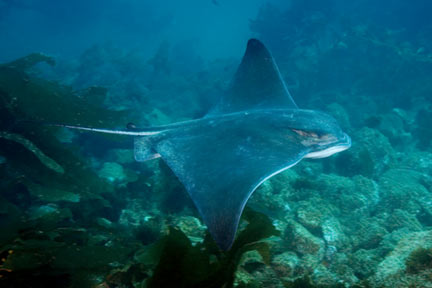
California Bat Ray |
|
Photograph copyright Andy Murch all rights reserved View all available California Bat Ray Pictures in the Shark Pictures Database Bat Ray, California Bat Ray, Californian Eagle Ray. Latin Name: Myliobatis californicus Family: Myliobatididae Identification: Pectoral fin tips rounded. Subrostral lobe (beak) short and rounded. Small dorsal fin positioned just behind the posterior edge of the pelvic fins. Dorsum uniformly brown, olive, or black. Albinism reported but rare. Disc width more than 1.5 x length. Long slender whip-like tail with elongated finely serrated tail sting. Size: Maximum disc width 1.8m. at birth 20-31cm. Habitat: Usually found in sandy or muddy bays and less frequently on rocky reefs and in kelp forests. Intertidal To about 50m but Bat Rays will migrate over deeper water when traveling between islands. Abundance and distribution: Endemic to the eastern Pacific from Yaquina Bay in northern Oregon to the Gulf of California. Common along the Californian coastline and around the Channel Islands. Maintains a small home range Behavior: Solitary or schooling. Large schools made up of thousands of bat rays have been seen around the Channel Islands. Bat Ray schools in Baja may contain Spotted Eagle Rays where as northern populations may school with Smoothhound Sharks. Individuals are sometimes found resting on the sand in excavated depressions. Diet: Feeds by pushing its snout through the mud or sand to find invertibrates. Also flexes its pectoral fins while on the substrate to create enough suction to pull sand away exposing prey animals. Diet includes clams, worms, abalone. oysters, snails, shrimps, crabs, and bony fishes. Reproduction: Ovoviviparous. Observations: California Bat Rays can sometimes be located by following clouds of floating silt and sand upstream until the animal is found exposing prey. Photographs: Catalina Island, California. Similar species: Reaction to divers: Difficult to approach. Skittish. Will move away upon sensing a divers approach. Tactics to get near include swimming slowly along the bottom in a non-threatening way i.e. without erratic movements and at an indirect angle. Diving logistics: California Bat Rays are often encountered while diving in the kelp forests around Catalina Island. Two dive companies in Avalon (the only town) can arrange charters to the best sites but they cannot guarantee that Bat Rays will show up. Shore divers in Southern California regularly see Bat Rays along the shoreline just outside the surf. Try to get up to date advice from locals on the specifics of where and when to plan a dive. The beach divers at La Jolla Shores find Bat Rays in the presence of Leopard Sharks during the summer and fall. Other diving locations submitted by readers: Further reading: Sharks, Rays, and Chimaeras of California. David E.Ebert. Reef Sharks and Rays of the World. Scott W. Michael. Sea Challengers. Sharks
and Rays - Elasmobranch Guide of the World. Ralf M. Hennemann. IKAN.
|
|
|
|
SHARK TRIPS |
 |
 |
 |
 |
 |
 |
 |
 |
|
MORE EXPEDITIONS |
 |
 |
 |
 |
 |
 |
 |
 |
 |
 |
 |
 |
|
|
|
SPONSORS |
 |
 |
|
ADVERTISERS |
|
|


|
|
|
ELASMO-BLOGS |
 |
 |
 |
 |
 |