|
|
|
SHARK INFO |
|
SHARK |
|
SHARK EVOLUTION |
|
|
|
SHARK DIVING |
|
SHARK DIVING 101 |
|
|
|
CONSERVATION |
|
|
|
PHOTOGRAPHY |
|
SHARK PHOTO TIPS |
|
|
|
RESOURCES |
|
|
|
WEB STUFF |
|
WHAT IS ELASMODIVER? Not just a huge collection of Shark Pictures: Elasmodiver.com contains images of sharks, skates, rays, and a few chimaera's from around the world. Elasmodiver began as a simple web based shark field guide to help divers find the best places to encounter the different species of sharks and rays that live in shallow water but it has slowly evolved into a much larger project containing information on all aspects of shark diving and shark photography. There are now more than 10,000 shark pictures and sections on shark evolution, biology, and conservation. There is a large library of reviewed shark books, a constantly updated shark taxonomy page, a monster list of shark links, and deeper in the site there are numerous articles and stories about shark encounters. Elasmodiver is now so difficult to check for updates, that new information and pictures are listed on an Elasmodiver Updates Page that can be accessed here:
|
|
_ |
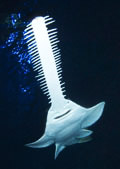
COMMON EAGLE RAY |
|
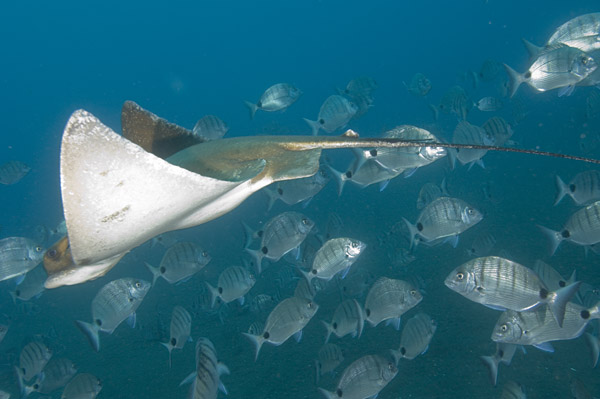
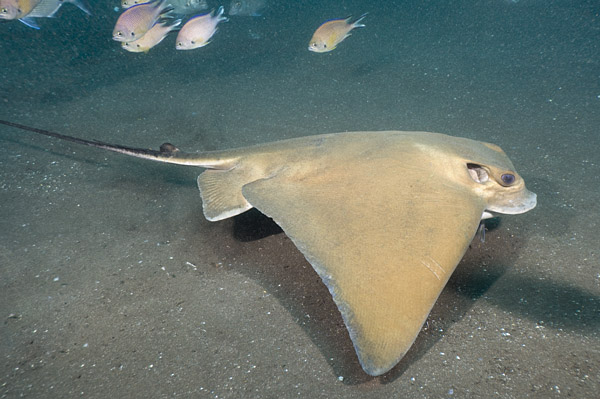
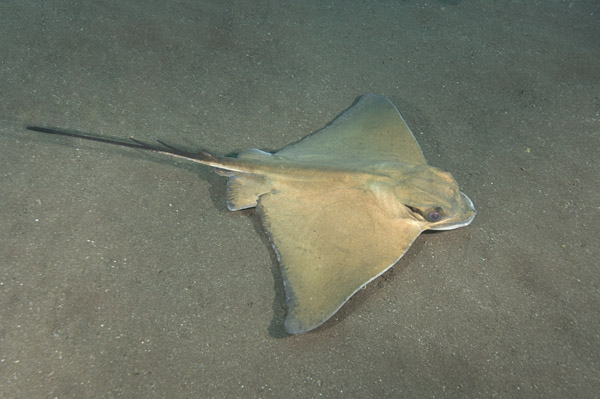
Photograph copyright Andy Murch all rights reserved View all available Common Eagle Ray Pictures Common Eagle Ray, Eagleray, Bull Ray. More common names below text. Latin Name: Myliobatis aquila Family: Myliobatididae Identification: Pectoral fins narrow and rounded. Subrostral lobe (beak) short and rounded. Dorsum uniformly brown without markings. Trailing edges of pectoral and pelvic fins dusky. Ventrum pale. One or more spines on tail behind single small rounded dorsal fin. Size: Wing span to 150cm. Habitat: Shallow bays and estuaries, sometimes near rocky reef faces, and over sand flats (where it feeds). To 300m depth. Abundance and distribution: A common species. Occurs from the southern North Sea to South Africa including the Mediterranean. Behavior: Feeds on clams, snails, crabs, worms, sea squirts, and small bony fishes. Excavates it's prey from under the sand by flapping its powerful pectoral fins. Reproduction: Ovoviviparous. The male Common Eagle Ray possesses large tubercles (modified skin denticles) that they may use to help them lock onto the female while mating. Observations: Photographs: Los Gigantes, Tenerife, Canary Islands, Eastern Atlantic Ocean. Similar species: There are a number of other eagle / bull / bat rays some of which are very difficult to tell apart. The best reference is geographic location. Reaction to divers: Quite timid and difficult to approach except at feeds where the individual rays have been habituated to divers. See Below. Diving logistics: A great place to see and photograph common eagle rays is on one of the organized ray feeds at Los Gigantes in the Canary Islands. Los Gigantes Diving offers freestyle feeds once or twice per week. The divemaster takes a huge barrel of fish scraps to 60ft and offers them to the eagerly gathering ray species. After a while the human participants usually help themselves to some fish and wander off to interact with the rays on their own. The feed can be rather chaotic but the ray action is almost guaranteed. Other than numerous Common Eagle Rays, the attending species include common stingrays, roughtail rays, round stingrays and occasionally angel sharks, butterfly rays, and marbled torpedo rays. Very occasionally a large Bull Ray swims by. Further reading: Reef Sharks and Rays of the World. Scott W. Michael. Sea Challengers. Sharks
and Rays - Elasmobranch Guide of the World. Ralf M. Hennemann. IKAN. Other names of the Common Eagle Ray:
|
|
|
|
SHARK TRIPS |
 |
 |
 |
 |
 |
 |
 |
 |
|
MORE EXPEDITIONS |
 |
 |
 |
 |
 |
 |
 |
 |
 |
 |
 |
 |
|
|
|
SPONSORS |
 |
 |
|
ADVERTISERS |
|
|


|
|
|
ELASMO-BLOGS |
 |
 |
 |
 |
 |