|
|
|
SHARK INFO |
|
SHARK |
|
SHARK EVOLUTION |
|
|
|
SHARK DIVING |
|
SHARK DIVING 101 |
|
|
|
CONSERVATION |
|
|
|
PHOTOGRAPHY |
|
SHARK PHOTO TIPS |
|
|
|
RESOURCES |
|
|
|
WEB STUFF |
|
WHAT IS ELASMODIVER? Not just a huge collection of Shark Pictures: Elasmodiver.com contains images of sharks, skates, rays, and a few chimaera's from around the world. Elasmodiver began as a simple web based shark field guide to help divers find the best places to encounter the different species of sharks and rays that live in shallow water but it has slowly evolved into a much larger project containing information on all aspects of shark diving and shark photography. There are now more than 10,000 shark pictures and sections on shark evolution, biology, and conservation. There is a large library of reviewed shark books, a constantly updated shark taxonomy page, a monster list of shark links, and deeper in the site there are numerous articles and stories about shark encounters. Elasmodiver is now so difficult to check for updates, that new information and pictures are listed on an Elasmodiver Updates Page that can be accessed here:
|
|
_ |
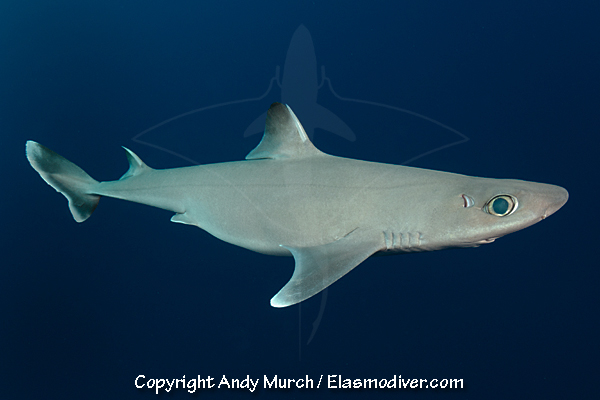
CUBAN DOGFISH |
|
View more Cuban Dogfish Pictures Cuban dogfish Latin Name: Squalus cubensis Family: Squalidae Identification: Slender body. Dordal fin origin level with pectoral fin insertion. Caudal fin unnotched. Anal fin absent. Dorsal fin tips dusky or black. Fin spines long (extending almost to apex). White margin on trailing edge of all fins (more obvious on caudal and pectoral fins). Eyes large and green with golden rims (eyelids). Dorsal fins relatively low. Dorsal coloration grey to brown above without markings. Ventral coloration pale. Size: Maximum length 110cm. size at birth 22-33 cm. Habitat: Rocky slopes from 60 to at least 380m. Recent long-lining surveys in Cape Eleuthera indicate that Cuban dogfish may inhabit considerably deeper depths. Abundance and distribution: The Cuban dogfish is restricted to two main groups in the western Atlantic. In the northern hemisphere it has been recorded in the USA and Mexico (including much of the Gulf of Mexico), Bahamas and the Caribbean chain as far south as Venezuela. In the southern hemisphere it can be found in southern Brazil and Argentina. Conservation Status: Data Deficient according to the IUCN. However, data deficient simply implies that not enough scientific studies or fisheries data has been collected to make a valid judgment on the state of this species. The IUCN Red List does state that "Mainly caught in the northern Gulf of Mexico (FAO 2002, Rodriguez 1996 ) although separate statistics are not reported for this species. Taken as by-catch in the San Andres Archipelago industrial fishery (Caldas 2002) and Panamanian artisanal fishery (Monzini 2004). Possible threat from a potential increase of deep sea fishery". Behavior: Forms dense schools. Diet: Feeds on benthic fishes and invertebrates. Tagged specimens were caught on a variety of baits including cobia, bonito and shark. Reproduction: Ovoviviparous. Litter size up to 10. Photographs: Exuma Sound, Bahamas. Images were taken with the help of Dr Edd Brooks from the Cape Eleuthera Institute. Edd is in charge of the shark monitoring program. Similar species: Sometimes confused with the shortspine spurdog (Squalus mitsukurii) which has less distinct dusky fin tips, more angular fins and a longer snout. Reaction to divers: Cuban dogfish inhabit water too deep to be encountered by divers. Captured specimens showed no aggressive behaviour. Diving logistics: N/A References: IUCN Red List Cuban Dogfish Report: http://www.iucnredlist.org/apps/redlist/details/61416/0
|
|
|
|
SHARK TRIPS |
 |
 |
 |
 |
 |
 |
 |
 |
|
MORE EXPEDITIONS |
 |
 |
 |
 |
 |
 |
 |
 |
 |
 |
 |
 |
|
|
|
SPONSORS |
 |
 |
|
ADVERTISERS |
|
|


|
|
|
ELASMO-BLOGS |
 |
 |
 |
 |
 |