|
|
|
SHARK INFO |
|
SHARK |
|
SHARK EVOLUTION |
|
|
|
SHARK DIVING |
|
SHARK DIVING 101 |
|
|
|
CONSERVATION |
|
|
|
PHOTOGRAPHY |
|
SHARK PHOTO TIPS |
|
|
|
RESOURCES |
|
|
|
WEB STUFF |
|
WHAT IS ELASMODIVER? Not just a huge collection of Shark Pictures: Elasmodiver.com contains images of sharks, skates, rays, and a few chimaera's from around the world. Elasmodiver began as a simple web based shark field guide to help divers find the best places to encounter the different species of sharks and rays that live in shallow water but it has slowly evolved into a much larger project containing information on all aspects of shark diving and shark photography. There are now more than 10,000 shark pictures and sections on shark evolution, biology, and conservation. There is a large library of reviewed shark books, a constantly updated shark taxonomy page, a monster list of shark links, and deeper in the site there are numerous articles and stories about shark encounters. Elasmodiver is now so difficult to check for updates, that new information and pictures are listed on an Elasmodiver Updates Page that can be accessed here:
|
|
_ |
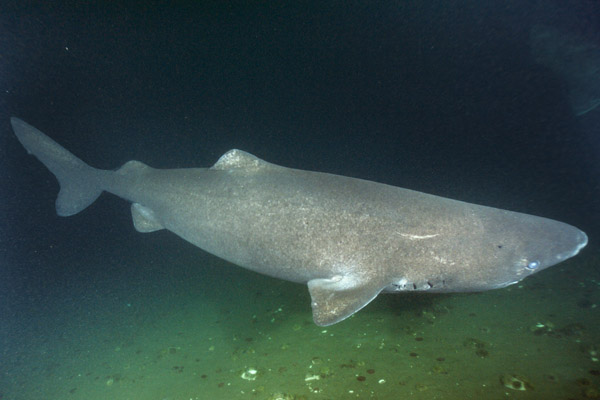
Greenland Shark |
|
View all available Greenland Shark Pictures Greenland Shark, Slurry Shark, Atlantic Sleeper Shark, Ground Shark. Latin Name: Somniosus microcephalus Family: Somniosidae - Sleeper sharks. Identification: A large, heavy bodied shark. Very low first and second dorsal fins set well back on body. Snout broadly rounded. Small light blue eyes often with trailing parasites. Dorsal coloration mottled grey/brown. Ventrum also mottled but lighter. No dorsal spines. Size: Maximum length 8 meters (Largest squaloid and 4th largest shark) size at birth 40 cm. Habitat: From surface to at least 2200m on mud flats and rocky reefs. Enters shallow bays and brackish river mouths possibly to feed. Temperature range from 1 - 12 degrees. Distribution: Arctic and North Atlantic Oceans. Eastern Canada and New England to Northern Europe. Occasionally as far south as France. Diet and behavior: Moves sluggishly over seabed. May be prone to spurts of acceleration when feeding as pinnipeds are part of diet. One animal had the remains of a caribou in its stomach. Feeds on pelagic and bottom fishes (herring, Atlantic salmon, Arctic char, capelin, redfish, sculpins, lumpfish, cod, haddock, Atlantic halibut, Greenland halibut and skates, sharks and skates, seals and small cetaceans, sea birds, squids, crabs, amphipods, marine snails, brittle stars, sea urchins, and jellyfish. Possibly utilizes parasite to lure prey but the parasitic copepod that attaches to eye has been shown not to be bioluminescent. Reproduction: Ovoviviparous.
Litter size from 1- 10. Low population doubling time - 14 years. Photographs: Baie Comeau, Quebec, Canada. Similar species: Pacific sleep shark. Reaction to divers: Apparently curious. In Baie Comeau, Greenland sharks slowly materialize from the depths and closely approach divers, sometimes remaining within visibility for 20 minutes or more. If accidentally touched or blocked, they are easily spooked. Some divers have used repetitive banging noises to attract the sharks. Greenland Sharks retreat from bright lights and camera flashes. Diving logistics: The only place to reliably dive with Greenland Sharks is in a few small bays around Baie Comeau in Quebec, Canada. Silvain Sirois leads trips during the summer months that have a good rate of success but sometimes the sharks show up late in the season or leave early. Non-english names:
References:
|
|
|
|
SHARK TRIPS |
 |
 |
 |
 |
 |
 |
 |
 |
|
MORE EXPEDITIONS |
 |
 |
 |
 |
 |
 |
 |
 |
 |
 |
 |
 |
|
|
|
SPONSORS |
 |
 |
|
ADVERTISERS |
|
|


|
|
|
ELASMO-BLOGS |
 |
 |
 |
 |
 |