|
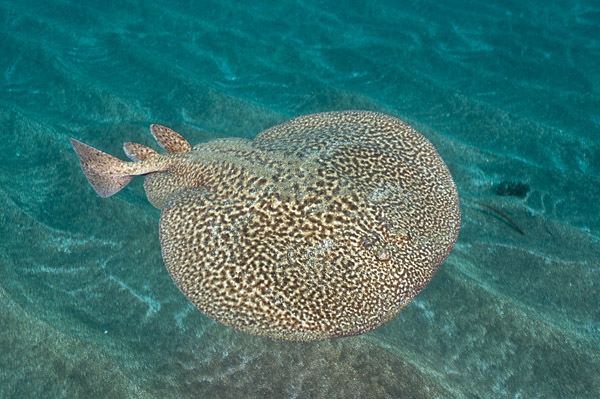
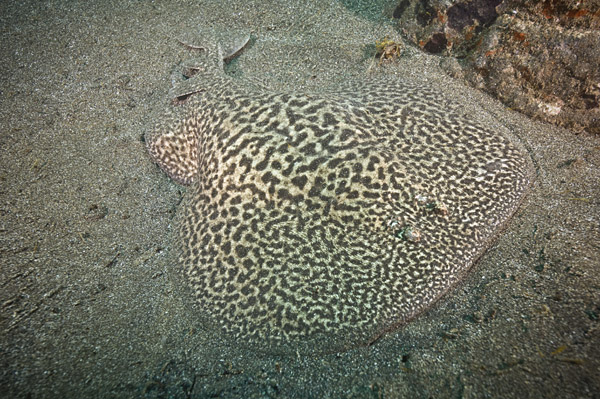
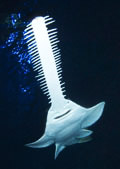
Photograph copyright Andy Murch
View all available Marbled Torpedo Ray Pictures in the
shark picture database
Common Names:
Marbled Torpedo Ray, Marbled Electric Ray, Spotted Torpedo.
Binomial:
Torpedo marmorata.
Family:
Torpedinidae.
Identification:
Disc width greater than length. Tail short with
well developed upper and lower caudal lobes. Two dorsal fins run along tail from
mid base of pelvic fins. Eyes small and close to spiracles. Spiracles have 6 to
8 papillae. Dorsal coloration consists of a maze of bold, dark brown irregular
lines and spots on a tan or cream background forming a marbled pattern.
Occasionally, dorsum uniformly brown. Pattern continues on border of ventrum.
Centre of ventrum white.
Size:
At birth 20cm. Maximum length 60cm.
Habitat:
Shallows to 200m on sand or mud and in sea grass
flats. Often seen around rocky reefs.
Distribution:
Eastern Atlantic from the North Sea to South
Africa.
Behavior:
Lays motionless for most of the day under sand with only
spiracles protruding. Diet consists mainly of bony fishes. Also consumes
octopuses and shrimps. Stuns its prey by discharging electricity that is stored
in large kidney shaped muscle like organs in the pectoral fins.
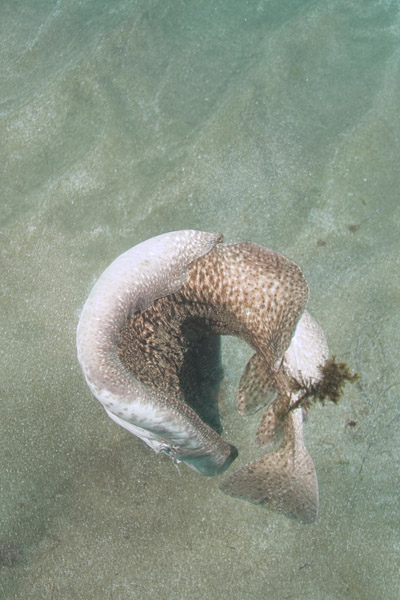
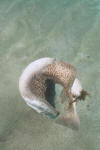
When threatened the Marbled Torpedo
Ray will swim off the bottom and curl its body into a circle thus presenting its
attacker with the area that emits its high voltage shock. Click on the thumbnail
below to see an example of this threat posture:
Reproduction:
Ovoviviparous.
the embryos are fed by ingesting a nutrient rich liquid that the mother secretes
into the uteri. 5 to 32 young are born after a 10 month gestation period.
Observations:
After wafting the sand away from one specimen it initially tried to swim
slowly away. Eventually it gave up this tactic and shot forward close to the
bottom in order to disrupt a cloud of sand. It made to leave and then circled
back at lightning speed and immediately buried itself. This maneuver took less
than a second but was extremely effective as the torpedo ray became completely
invisible.
Another specimen adopted the threat
posture explained above but it did not attempt to shock me. This may be due to
the distance that I kept from it.
Photographs:
El Cabron Marine Park, Arinaga, Gran Canaria,
Canary Islands.
Similar species:
At least 4 other torpedo rays share parts of
the Marbled Torpedo Ray's range. Most are distinguishable by their markings:
Common Torpedo - 5 distinct ble ocelli on back. Bauchot's Torpedo - tan dorsum
with darker flecks bordered in black spots. Mackay's Torpedo - brown dorsum
covered in small white polka dots. Atlantic Torpedo - plain brown to purple
dorsum and first dorsal fin significantly larger than second.
Reaction to divers:
Easily approached. moves away only when closely
disturbed. May shock if handled. Divers have reported being shocked after
accidentally coming to rest on top of this ray.
Diving logistics:
Davy Jones Diving Centre (among others) runs trips to El Cabron Marine Park
where this ray can usually be found by patient and observant divers. Shore
diving without a guide is also possible but advice should be sought from local
dive shops on water conditions and currents.
This is a wide ranging ray that can
probably be seen in a variety of places but the Marbled Torpedo
Ray is fairly abundant in the Canary Islands which are easily accessible to
divers.
El Cabron is also an excellent place
to hunt for Common Angel Sharks.
Other diving locations submitted by readers:
Further Reading:
Sharks and Rays
Elasmobranch Guide of the World
- Ralf M. Hennemann.
|