Not just a
huge collection of
Shark
Pictures:
Elasmodiver.com contains images of sharks, skates, rays, and a few
chimaera's from around the world. Elasmodiver began as a simple web
based
shark
field guide
to help divers find the best places to encounter the different
species of sharks and rays that live in shallow water but it has
slowly evolved into a much larger project containing information on
all aspects of shark diving and shark photography.
There are
now more than 10,000 shark pictures and sections on shark
evolution, biology, and conservation. There is a large library of
reviewed shark books, a constantly updated shark taxonomy page, a
monster list of shark links, and deeper in the site there are
numerous articles and stories about shark encounters. Elasmodiver is
now so difficult to check for updates, that new information and
pictures are listed on an Elasmodiver Updates Page that can be
accessed here:
Amazingly, there are still new species of sharks and rays
being described by
science on a regular basis. In some cases they have been well known for a while (e.g. the
Western wobbegong) but no one has gotten around to describing them. More
exciting is when a deep water trawl or a lucky diving expedition uncovers a
species that the scientific community was
completely unaware of. This page on elasmodiver.com highlights the
discovery of some of these species. Many thanks to Helmut Nickel who somehow manages
to find out whenever a new species is described and diligently informs the
rest of the lay community of shark fanatics through the Shark-L web forum.
Without his input I wouldn't have a clue.
If
you have information about a species I have overlooked please email me the information and
I will add it to the list.
Recent Sharks and
Rays Previously Unknown to Science or Previously Undescribed:
Etmopterus benchleyi
n. sp., a new lanternshark (Squaliformes: Etmopteridae) from the central
eastern Pacific Ocean
Victoria E. Vásquez, David A. Ebert, & Douglas J. Long.
ABSTRACT: A new species of lanternshark, Etmopterus benchleyi n. sp., is
described from eight specimens collected off the Pacific coast of
Central America at depths ranging between 836 and 1443 meters. The new
species is placed in the Etmopterus spinax clade by a lack of flank
markings and the moderately short, slender, hook-like, conical dermal
denticles distributed over the body. It can be distinguished from its
closest congeners based on a combination of coloration, proportional
body measurements, meristic counts, arrangement of dermal denticles, and
size at maturity. The dorsal fins of the new species are either similar
in size or the second dorsal fin is slightly larger than the first vs.
the second dorsal fin distinctly larger than the first in E. granulosus,
E. princeps, and E. litvinovi. The pre-oral length is shorter in the new
species (6.9–9.0% TL) than in its closest congeners, E. granulosus
(7.9-11.3% TL) and E. princeps (9-10% TL). The tooth count in the lower
jaw is higher in E. benchleyi (30–36) than in E. granulosus (28), but
lower than in E. litvinovi (40–50) and E. princeps (40–50). Photophores
in E. benchleyi are sparse compared to other etmopterids and difficult
to identify due to its uniform black color. This new species is also
distinct from other members of the E. spinax clade in having dense
concentrations of dermal denticles closely surrounding the eyes and gill
openings. E. benchleyi is the only Etmopterus species presently known
from the Pacific coast of Central America.
Journal of the Ocean Science Foundation 17: 43-55.
Chimaera carophila (Chondrichthyes: Chimaeriformes: Chimaeridae),
a new species of chimaera from New Zealand
Abstract: A new
species of chimaeroid, Chimaera carophila sp. nov., is described
from 37 specimens collected from deepwater slopes and seamounts
around New Zealand. The new species is distinguished from its
closest congeners, Chimaera fulva Didier et al. 2008, Chimaera
macrospina Didier et al. 2008, and Chimaera obscura Didier et
al. 2008, by its uniform pale-brown coloration, geographic
distribution, and a combination of morphological characters,
including longer dorsal and ventral caudal fin bases, a shorter
first dorsal fin height, a shorter dorsal fin spine, and shorter
claspers that are divided distally for one-third of their
length. Chimaera carophila sp. nov. also can be distinguished
from closely related species in New Zealand and Australian
waters based on DNA sequence divergence of the NADH2 gene.
Comparisons of body size in a large sample of specimens show
considerable overlap in character ranges among congeners making
species distinctions difficult. New combinations of
morphometrics are suggested including ratios of head length to
eye length and dorsal spine length to head length, to better
distinguish among species of chimaeroids that are similar in
overall appearance and size. Also, a key to New Zealand and
Australian Chimaera species is provided.
Heliotrygon gomesi,
n. sp. and
Heliotrygon rosai,
n. sp.,
Morphology and phylogenetic relationships of a
remarkable new genus and two new species of Neotropical
freshwater stingrays from the Amazon basin (Chondrichthyes:
Potamotrygonidae)
MARCELO R. DE CARVALHO
1 &
NATHAN R. LOVEJOY
2
Abstract:
The
morphology and phylogenetic relationships of a new genus and two
new species of Neotropical freshwater stingrays, family
Potamotrygonidae, are investigated and described in detail. The
new genus,
Heliotrygon,
n. gen., and its two new species,
Heliotrygon gomesi,
n. sp. (type-species) and
Heliotrygon rosai,
n. sp., are compared to all genera and species of
potamotrygonids, based on revisions in progress. Some of the
derived features of
Heliotrygon
include its unique disc pro- portions (disc highly circular,
convex anteriorly at snout region, its width and length very
similar), extreme subdivision of suborbital canal (forming a
complex honeycomb-like pattern anterolaterally on disc), stout
and triangular pelvic girdle, extremely reduced caudal sting,
basibranchial copula with very slender and acute anterior
extension, and precerebral and frontoparietal fontanellae of
about equal width, tapering very little posteriorly. Both new
species can be distinguished by their unique color patterns:
Heliotrygon gomesi is
uniform gray to light tan or brownish dorsally, without distinct
patterns, whereas
Heliotrygon rosai is
characterized by numerous white to creamy-white vermiculate
markings over a light brown, tan or gray background color.
Additional proportional characters that may further distinguish
both species are also dis- cussed. Morphological descriptions
are provided for dermal denticles, ventral lateral-line canals,
skeleton, and cranial, hyoid and mandibular muscles of
Heliotrygon,
which clearly corroborate it as the sister group of
Paratrygon.
Both genera share numerous derived features of the ventral
lateral-line canals, neurocranium, scapulocoracoid, pectoral
basals, clasper morphology, and specific patterns of the
adductor mandibulae and spiracularis medialis muscles.
Potamotrygon and
Ple- siotrygon are
demonstrated to share derived characters of their ventral
lateral-line canals, in addition to the presence of angular
cartilages. Our morphological phylogeny is further corroborated
by a molecular phylogenetic analysis of cyto- chrome
b based
on four sequences (637 base pairs in length), representing two
distinct haplotypes for
Heliotrygon gomesi.
Parsimony analysis produced a single most parsimonious tree
revealing
Heliotrygon and
Paratrygon as
sister taxa (boot- strap proportion of 70%), which together are
the sister group to a clade including
Plesiotrygon and
species of
Potamotry- gon.
These unusual stingrays highlight that potamotrygonid diversity,
both in terms of species composition and undetected
morphological and molecular patterns, is still poorly known.
JOÃO PEDRO FONTENELLE1,
JOÃO PAULO C. B. DA SILVA & MARCELO R. DE CARVALHO
Departamento de Zoologia, Instituto de Biociências,
Universidade de São Paulo, Rua do Matão, Travessa 14, no. 101,
CEP 05508- 090, São Paulo, SP, Brazil. E-mails: jpfontenelle@ib.usp.br
(JPF); jpcbs@ib.usp.br (JPCBS); mrcarvalho@ib.usp.br (MRC)
1Corresponding
author
Abstract:
Potamotrygon limai,
sp. nov., is described from the Jamari River, upper Madeira
River system (Amazon basin), state of Rondônia, Brazil. This
new species differs from congeners by presenting unique
polygonal or concentric patterns formed by small whitish spots
better defined over the posterior disc and tail-base regions.
Potamotrygon limai,
sp. nov., can be further distinguished from congeners in the
same basin by other characters in combination, such as two to
three rows of midtail spines converging to a single irregular
row at level of caudal sting origin, proportions of head, tail
and disc, patterns of dermal denticles on rostral, cranial and
tail regions, among other features discussed herein.
Potamotrygon limai,
sp. nov., is most similar to, and occurs sympatrically with,
P. scobina,
and is distinguished from it by lacking ocellated spots on disc,
by its characteristic polygonal pattern on posterior disc, a
comparatively much shorter and broader tail, greater intensity
of denticles on disc, more midtail spine rows at tail-base, and
other features including size at maturity and mer- istic
characters.
Potamotrygon limai,
sp. nov., is also distinguished from other species of
Potamotrygon
occurring in the Amazon region, except
P. scobina,
by presenting three angular cartilages (vs. two or one). This
new species was discov- ered during a detailed taxonomic and
morphological revision of the closely related species
P. scobina,
and highlights the necessity for thorough and all-embracing
taxonomic studies, particularly in groups with pronounced
endemism and mor- phological variability.
Authors:
William T. Whitemail,
Keisuke Furumitsu, Atsuko Yamaguchi.
Abstract:
Recent taxonomic and molecular work on the eagle rays (Family
Myliobatidae) revealed a cryptic species in the northwest Pacific. This
species is formally described asAetobatus
narutobieisp.
nov. and compared to its congeners.Aetobatus
narutobieiis
found in eastern Vietnam, Hong Kong, China, Korea and southern Japan. It
was previously considered to be conspecific withAetobatus
flagellum,
but these species differ in size, structure of the NADH2 and CO1 genes,
some morphological and meristic characters and colouration.Aetobatus
narutobieiis
particularly abundant in Ariake Bay in southern Japan where it is
considered a pest species that predates heavily on farmed bivalve stocks
and is culled annually as part of a ‘predator control’ program. The
discovery ofA.
narutobieihighlights
the paucity of detailed taxonomic research on this group of rays. This
discovery impacts on current conservation assessments ofA.
flagellumand
these need to be revised based on the findings of this study.
Authors: PETER R. LAST1, HSUAN-CHING HO2,3,* & ROU-RONG
CHEN3 1
Abstract:
A new species of wedgefish, Rhynchobatus immaculatus sp.
nov., is described from a small collection of specimens ob- tained from
fish markets in northern Taiwan. It is probably a medium-sized species
(probably attaining ca. 1.5 m TL) be- cause the largest known specimen,
an immature male (ca. 1 m TL), has prolongated dorsal and caudal fins
typical of adult wedgefishes. Rhynchobatus immaculatus is unique within
the family in having a very high vertebral count (within the range of
165–170 total free centra) and in lacking a dark pectoral marking. Other
Rhynchobatus species occurring in Tai- wanese seas appear to attain a
larger adult size, possess a dark pectoral marking at least in young,
and have lower vertebral counts (fewer than 161 total fee centra).
Rhynchobatus yentinesis, which was described from a specimen taken
nearby at Wenzhou, China, has not yet been attributed to a currently
recognised species. However, based on the illustration of the holotype,
which reveals a broad-snouted species with a dark pectoral spot, it is
closest to either R. palpebratus or R. springeri.
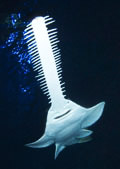
Pristiophorus Nancyae a New Species of Sawshark (Chondrichthyes:
Pristiophoridae) from Southern Africa
Authors: Ebert, David A.; Cailliet, Gregor M.
Source: Bulletin of Marine Science, Volume 87, Number 3, July 2011 , pp.
501-512(12)
Publisher: University of Miami - Rosenstiel School of Marine and Atmospheric
Science
Abstract:
A new species of sawshark, Pristiophorus nancyae sp. nov., is described from
eight specimens collected off mozambique. The new species is the second
member of the family pristiophoridae and first member of the genus
Pristiophorus described from the western indian ocean. The new Pristiophorus
species can be distinguished from the sympatric occurring six-gilled
sawshark, Pliotrema warreni regan, 1906, most notably by having five paired
gill openings as opposed to six. The new species is distinguished from all
other Pristiophorus species by several distinctive characteristics. most
notably, the new species differs by having a very distinctive double row of
four to five conspicuous large pits anterior to the nasal barbels on the
underside of its snout. other distinguishing characteristics include a
broad, triangular first dorsal fin with a rear tip that extends behind the
pelvic midbases, barbels much closer to mouth than snout tip, two rows of
enlarged pits on the underside of the pre-barbel rostrum, ridges on the base
of its large lateral rostral teeth, mostly tricuspidate, flat, imbricated
lateral trunk denticles, and plain color pattern. The new species is
compared to the five other known Pristiophorus species and a revised key to
the genus is presented.
Published in June 2012
New deep water skates of the genus Notoraja Ishiyama, 1958 (Rajoidei,
Arhynchobatidae) from the southwest Pacific
Bernard Séret and Peter R. Last
ABSTRACT:
Four new skates of the genus Notoraja Ishiyama, 1958 are described from
the rarely accessed, deep waters off New Caledonia, Vanuatu and Fiji
islands, and the Norfolk Ridge. Three of these (N.
alisae n. sp., N. longiventralis
n. sp. and N. fijiensis n. sp.) are
“velcro skates” which are characterised by their velvety dorsal and
ventral surfaces, covered with fine denticles. Although similar in
shape, they differ by their colour pattern, dermal armature, development
of the lateral tail folds, and size of the pelvic-fin anterior lobe and
nasal curtain. The description of the fourth species,
Notoraja inusitata n. sp., is based on
a juvenile male exhibiting some unusual features resembling those of
other skate genera.
Zoosystema 34 (2): 319–341.
Himantura randalli
sp. nov., a new whipray (Myliobatoidea: Dasyatidae) from the Persian
Gulf
Posted: 04 Jun 2012 01:40 AM PDT
Published on 29. May 2012
Peter R. Last, B. Mabel Manjaji-Matsumoto & Alec B. M. Moore
ABSTRACT:
A new whipray, Himantura randalli sp. nov., described from material
collected off Bahrain, Kuwait and Qatar, appears to be endemic to the
Persian Gulf. It has been frequently confused with forms of the more
widely distributed whipray Himantura gerrardi Gray and other presently
unidentified species from the Indian Ocean. Himantura randalli sp. nov.
is distinguished from these species by a combination of characters, i.e.
disc shape, morphometrics, squamation (including its rapid denticle
development and denticle band shape), plain dorsal disc coloration, and
whitish saddles on a dark tail in young. It is a medium-sized whipray
with a maximum confirmed size of 620 mm disc width (DW) and a birth size
of around 150–170 mm DW. Males mature at approximately 400 mm DW.
Himantura randalli sp. nov. is relatively abundant in the shallow,
soft-sedimentary habitats of the Persian Gulf from where it is commonly
taken as low-value or discarded bycatch of gillnet and trawl fisheries.
Zootaxa 3327: 20–32 (2012)
A new species of softnose skate from New Caledonia
Posted: 29 Jan 2012 09:36 AM PST
Published online on 26. January 2012. Bathyraja leucomelanos, a new
species of softnose skate (Chondrichthyes: Arhynchobatidae) from New
Caledonia
Samuel Paco Iglésias and Lauriana Lévy-Hartmann
ABSTRACT:
A new species of softnose skate (Arhynchobatidae) is described, based on
a single adult male measuring 895 mm TL that was collected at a depth of
953–1,022 m on the Coriolis Bank off western New Caledonia in the
southwestern Pacific Ocean. The specimen conforms to the genus Bathyraja
in having the rostral cartilage continuous with the neurocranium and
very slender and uncalcified over its length. Bathyraja leucomelanos sp.
nov. differs from its congeners through a combination of the following
characters: distinctive coloration of the disc with white dorsal and
black ventral surfaces, dorsal surface of the disc entirely covered with
dermal denticles, ventral surface naked, anterior portion of the
anterior margin of the disc straight, snout long and very broad with
orbit about 6.0 times in preorbital length, orbit 0.73 times
interorbital width, mouth 6.8% TL, tail 0.88 times precloacal length,
accessory terminal 2 cartilage of the clasper having an expanded
disc-shaped tip, and alar thorn tip undulating. Molecular barcoding from
the COI sequence reveals that this new species is genetically close to
B. spinicauda from the North Atlantic Ocean.
Ichthyological Research Volume 59, Number 1, 38-48, DOI:
10.1007/s10228-011-0254-y
" Resurrection of the name
Carcharhinus cerdale, a species different
from Carcharhinus porosus "
José I. Castro.
Abstract:
The smalltail shark, Carcharhinus porosus Ranzani, 1840, is a small
shark that inhabits the western North Atlantic Ocean from the Gulf of
Mexico to Brazil. Carcharhinus cerdale Gilbert, in Jordan and Evermann,
1898, is a small shark that inhabits the eastern Pacific from the Gulf
of California to the tropics. Through a series of mistakes these two
allopatric species were synonymized. Meek & Hildebrand (1923) probably
committed the first error when they misidentified or assumed the origin
of market specimens in Colón, Panama, and stated that C. cerdale was
found in both sides of the Isthmus of Panama. Meek & Hildebrand did not
compare C. cerdale with C. porosus, and they did not synonymize the two
species. Bigelow & Schroeder (1948) made the second error by stating
that Meek & Hildebrand had synonymized C. cerdale and C. porosus. Their
publication was so authoritative that the synonymy would not be
challenged by most workers for more than 60 years, although Kato et al.
(1967) were aware that C. cerdale was different from the Atlantic C.
porosus. The name Carcharhinus cerdale Gilbert, in Jordan & Evermann,
1898, is resurrected here for the Pacific species.
Aqua International Journal of Ichthyology, Volume 17, Issue 1: 1-10.
" Squatina caillieti sp. nov., a new species of angel shark (Chondrichthyes:
Squatiniformes: Squatinidae)
from the Philippine Islands "
JONATHAN H. WALSH, DAVID A. EBERT and LEONARD J.V. COMPAGNO.
Abstract:
A new species of angel shark, Squatina caillieti sp. nov., is described
from a single specimen collected in deepwater off Luzon in the
Philippines. The new species is closest to S. formosa and S. nebulosa,
but differs from its congeners based on the following characters:
unfringed barbels with rod-like tips, upper lip arch semi-oval in shape,
large papillae present on the inside posterior margin of the spiracles,
a greater interspiracle space than interorbital space, pelvic fin-tips
which reach the first dorsal origin, a short pelvic fin base, short
pelvic inner margin very short, and a short pelvic posterior margin;
pelvic girdle span more than 1.4 times greater than head length; dorsal
fins angular, greater interdorsal space than dorsal caudal space; caudal
fin lobed, very short upper postventral caudal margin. The new species
is the only Squatina confirmed as occurring in the Philippines. We also
comment on the biogeography of western North Pacific Squatina and
provide a revised regional key to this group.
Rediscovery and description of the quagga shark, Halaelurus quagga (Alcock,
1899)
(Chondrichthyes: Scyliorhinidae) from the southwest coast of India K.V. AKHILESH1,3, K.K. BINEESH1, C.P.R. SHANIS1, B.A. HUMAN2 & U.
GANGA1
1Central Marine Fisheries Research Institute, PB No. 1603. Cochin-682
018, Kerala. India
2Research Associate, Department of Aquatic Zoology, Western Australian
Museum, Locked bag 49, Welshpool DC, Perth WA 6986,
Australia
3Corresponding author. E-mail: akhikv@gmail.com
Abstract
The Quagga shark Halaelurus quagga (Alcock, 1899) is one of the poorest
known scyliorhinid (Carcharhiniformes)
sharks of the world, described from a single specimen collected from the
Arabian Sea coast of India (off Malabar). Since
its description, the only other published reports of this species are of
specimens from Somalia. This paper reports on H.
quagga from Indian waters, more than 100 years after its description,
and only the third report of specimens of this species
globally. A re-description of H. quagga is also provided based on the
recent Indian specimens.
Key words: Rediscovery, Halaelurus quagga, Scyliorhinidae,
Carcharhiniformes, Arabian Sea, India
Introduction
Indian waters support a diverse chondrichthyan fauna consisting of more
than 150 known species (Raje et al.,
2007; Akhilesh et al., in prep.), with the actual number probably being
higher since there are no recent, exclusive
studies on this group from the region. Of the reported shark species,
some have a geographic distribution range
restricted to the western Indian Ocean (Compagno et al., 2005).
The Scyliorhinidae (Carcharhiniformes) is one of the largest and diverse
shark families with 17 genera, 146
recognized and described species, and at least 19 recognized but
undescribed species to date (Human & D.A. Ebert,
unpub. data), which is continually expanding with several species being
described since 2005 (Last et al., 2008;
Froese & Pauly, 2010). The Scyliorhinidae consist of very small sharks
that have no commercial importance and
very rarely occur as bycatch in shark fisheries of India.
Ten scyliorhinid shark species are reported from the Arabian Sea, of
which two belong to the genus Halaelurus:
H. boesemani, and H. quagga (Manilo & Bogorodsky, 2003; Human, in
prep.). Compagno et al. (2005) recognised
that the occurrence of H. natalensis needed confirmation; however
previous reports of H. natalensis from the
Arabian Sea are erroneous (Human, in prep.).
After the original description of H. quagga from the Arabian Sea coast
of India (off Malabar), the only other
reports of H. quagga came from off Somalia (Springer & D’Aubrey, 1972;
Springer, 1979). The holotype is the
only previously known specimen from India and this article presents the
second report of H. quagga from Indian
waters, over 100 years after its description. This is also the first
report of a female and egg case for the species, and
provides a re-description based on recent specimens collected from the
southwest coast of India (Kerala coast),
which are deposited at the Marine Biodiversity Museum at the Central
Marine Fisheries Research Institute
(CMFRI), Cochin, Kerala.
Chimaera notafricana sp.
nov. (Chondrichthyes: Chimaeriformes: Chimaeridae), a new species of
chimaera from southern Africa
JENNY M. KEMPER1, DAVID A. EBERT1, 2, 3, LEONARD J.V. COMPAGNO4 &
DOMINIQUE A. DIDIER5
1Pacific Shark Research Center, Moss Landing Marine Laboratories, 8272
Moss Landing Road, Moss Landing, CA 95039, USA.
E-mail: jkemper@mlml.calstate.edu
2Research Associate, South African Institute for Aquatic Biodiversity,
Private Bag 1015, Grahamstown, 6140, South Africa
3Research Associate, Department of Ichthyology, California Academy of
Sciences, 55 Music Concourse Drive, San Francisco, CA. 94118, USA
4Shark Research Center, Iziko – South African Museum, Cape Town, South
Africa
5Department of Biology, Millersville University, P.O. Box 1002,
Millersville, PA 17551 USA Abstract:
A new species of chimaera, Chimaera notafricana sp. nov., is described
from specimens collected off the west and south coasts of southern
Africa. The new species is distinguished from its closest congener, the
eastern North Atlantic Chimaera monstrosa, by a combination of
morphometric characters and coloration: pectoral fin when depressed
reaches to origin of pelvic fin base; caudal fin ventral margin
terminating slightly posterior to caudal fin dorsal margin insertion;
distance from anterior base of dorsal-fin spine to center of
supratemporal canal short (6.5–14.8% HDL); pelvic claspers externally
trifid and short (12.1–12.3% BDL), divided for distal one-third of
length, not extending past distal tip of pelvic fins; uniform blackish
brown with dark bluish streaking, precaudal tail with longitudinal light
and dark stripes. This new species has a restricted distribution from
Lüderitz, Namibia to south of Algoa Bay, Eastern Cape Province, South
Africa.
A newspecies of
chimaera, Hydrolagus melanophasma sp. nov.
(Chondrichthyes: Chimaeriformes: Chimaeridae), from the eastern North
Pacific.
Abstract:
A newspecies of
chimaera, Hydrolagus melanophasma sp. nov. (Chimaeridae),
is described from the eastern North Pacific. It is distinct from other
eastern Pacific chimaeroids by the following characteristics: a large
slightly curved
dorsal fin spine extending beyond dorsal fin apex, a long second dorsal
fin
of uniform height throughout, large pectoral fins extending beyond the
pelvic fin insertion when laid flat, trifid claspers forked for
approximately one-quarter the total clasper length and a uniform black
coloration throughout. The new
species is compared to other eastern Pacific
members of the genus Hydrolagus including H. alphus, H. colliei, H.
macrophthalmus, and H. mccoskeri. Remote Operated
Vehicle (ROV) video footage has identified and documented Hydrolagus
melanophasma from the Gulf of California.
ROV observations suggest that individuals typically occur over
soft-bottom
habitats or cobble patches with minimal vertical relief. This is in
contrast
to other eastern Pacific Hydrolagus species that
tend to occur in areas of
high rocky relief. The known distribution of this newspecies at present
extends from southern California, U.S.A., along the Pacific coast of
Baja
California, Mexico, and into the Gulf of California.
Paper published on July 31, 2009:
A new frilled shark species
was discovered in African waters.
David Ebert and Leonard Compagno.
"Chlamydoselachus africana, a newspecies of frilled shark from southern Africa
(Chondrichthyes, Hexanchiformes, Chlamydoselachidae)"
Abstract
Frilled sharks (Chondrichthyes, Hexanchiformes, Chlamydoselachidae),
long
believed to be a monotypic family and genus, consisting of a single wide
ranging species, Chlamydoselachus anguineus
(Garman, 1884), is now known to
contain at least two species. A
newspecies of frilled shark,
Chlamydoselachus africana, sp. nov., is described from five specimens
collected from southern Africa. The newspecies, although difficult to
distinguish externally from the well known C. anguineus, differ
internally
by the structural differences in the chondrocranium, lower total
vertebral
and spiral valve counts, and pectoral-fin radial counts. The
newspecies,
Chlamydoselachus africana, is known from off southern Angola, Namibia,
and
South Africa.
Zootaxa 2173: 1–18 (2009).
New Skate Species
Notoraja sapphira
Seret and Last 2009:
"Notoraja sapphira sp. nov. (Rajoidei: Arhynchobatidae), a
new deepwater skate
from the slopes of the Norfolk Ridge (South-West Pacific)".
Abstract:
A new arhynchobatid skate of the genus Notoraja
is described from five
specimens collected on the slopes of the Norfolk
Ridge between 1195 and 1313 m depth. The newspecies is distinct from its
sibling species from southern Australian
waters, the Blue Skate (N. azurea), by its smaller size, several
morphometric and meristic characters, thorn pattern and
dorsal and ventral coloration.
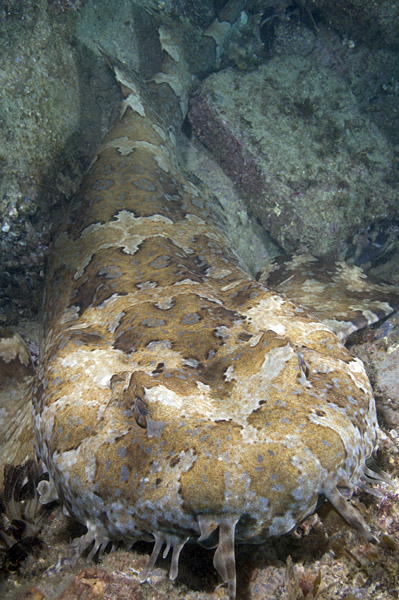
The Banded
wobbegong Orectolobus halei (originally described by Whitley in
1940) has been redescribed by Huveneers in 2006. It was previously
considered to be the adult form of the Ornate Wobbegong
Orectolobus
ornatus.
Bangkok, Thailand – A new
species of freshwater stingray has been discovered in a river in western
Thailand, but its chances for long-term survival are slim, warns WWF.
The new species of stingray,
measuring 60 centimeters (23.6 inches) in width, was first observed two
years ago but has only now been confirmed in detail as a new species by
researchers from WWF Thailand and the US-based Smithsonian Institute.
WWF Thailand’s Senior
Freshwater Biologist, Dr Chavalit Vidthayanon, along with Smithsonian
Research Associate Dr Tyson Roberts, have described in detail the new
freshwater stingray, known as Himantura kittipongi, found in the Mekong
Basin of western Thailand.
Thai rivers, including the
Mekong River where the ray is found, have been plagued by serious
pollution, overfishing and dam building, which have taken a deadly toll on
Thailand's once diverse and abundant river life. The ray is believed to
exist in only small numbers.
The new species was named Himantura kittipong after prominent Thai fish
expert Kittipong Jaruthanin who first observed the ray in 2004.
For more information: Radda Larpnun, Communications Manager WWF Thailand Email:
radda@wwfthai.org
Sphyrna sp.
Previously unknown species of hammerhead shark discovered
BY SUSAN COCKING Knight Ridder Newspapers
MIAMI - Scientists from Nova Southeastern University and the University of South Carolina have discovered a previously unknown species of hammerhead shark in the southeastern Atlantic.
The species - as yet unnamed - so closely resembles the scalloped
hammerhead (Sphyrna lewini) that the only ways to tell them apart are to compare DNA
and count vertebrae.
Mahmood Shivji, director of the Guy Harvey Research Institute at the NSU Oceanographic Center in Dania Beach, says the two species share the same waters but do not interbreed. Shivji adds that the cryptic, or
unrecognized species, may be less abundant than the scalloped, making it more
susceptible to fishing pressure.
''They're catching these things they don't know they're catching,'' Shivji said. ``You could wipe out a whole genetic lineage if you are not managing these species separately.''
Hammerhead sharks, of which there are believed to be eight species, occur worldwide. In U.S. waters, hammerheads are managed under the umbrella of
11 large coastal shark species - not including those on the federal
prohibited species list. Commercial fishing for large coastal sharks is regulated
through seasons and quotas.
The practice of finning - cutting off a shark's fins and discarding the carcass - is illegal in the United States but widely practiced around the world because fins are believed to have aphrodisiacal and medical
benefits. Hammerheads are particularly vulnerable because their fins are worth
hundreds of dollars per kilogram at markets in the Far East, while their meat is
much less valued. As a result, hammerhead abundance in the western Atlantic is believed to have declined by 89 percent since the mid-1980s, according to
a study by researchers at Canada's Dalhousie University published in the
journal Science in 2003.
TRAILBLAZERS
Shivji and his NSU colleagues are at the forefront of using genetics to identify sharks exploited in the international fin trade, which is how
they stumbled on the previously unknown species of hammerhead. In trying to
develop a DNA forensic marker for scalloped hammerheads, they collected 143
samples of Sphyrna lewini from around the world. They were puzzled to find that the
test worked on all the sharks except for three, which were caught by
recreational anglers off Fort Lauderdale.
At first, the scientists thought something was wrong with their forensic marker. But more extensive testing on the three South Florida sharks
showed their DNA was completely different from all other scalloped hammerheads
caught locally and around the world, suggesting a separate species.
''The genetic difference is greater between the new cryptic species and
the regular scalloped hammerhead than between the geographically separate populations of the scalloped hammerhead,'' Shivji said.
SIMILAR RESULTS
The startling discovery didn't create much of a stir at first. But coincidentally, scientists at the University of South Carolina came to the same conclusion, using genetic testing to separate eight anomalous sharks caught in their coastal waters. In a paper published online last December, they suggested that bays in their state serve as nurseries for the cryptic species, and should be protected. Intense fishing pressure, they warned,
could imperil both the scalloped hammerhead and the new species.
The scientists wrote: ``Concentrated reproduction in South Carolina
coastal waters also could increase the risk of extinction of the cryptic species.
. . . Data on the geographic distribution and relative abundance of both
scalloped hammerhead species is critical at this juncture and should be used to
evaluate current management plans.''
It is too soon to tell how the discovery of the previously unknown
hammerhead could affect shark management. NOAA Fisheries research biologist Enric
Cortes, who prepares shark-stock assessments for the U.S. east coast, calls the
news ``shocking -- it will be another curveball that will be thrown at us.''
Cortes says it will be difficult to separate the new hammerhead in stock assessments because it can only be recognized genetically. More likely, it would be lumped with the other large coastal sharks.
Meanwhile, Shivji said, more research is required to count and describe
it.
Said Shivji: ``This is the next project that needs to be done: What
population of scalloped hammerheads are the new cryptic species? Someone has to do
the taxonomy on this and give it a name.''
Mustelus hacat
Pérez Jiménez, Juan
Carlos, Nishizaki, Oscar Sosa, Castillo Geniz, José Leonardo A New Eastern North Pacific Smoothhound Shark (Genus Mustelus,
Family Triakidae) from the Gulf of California Copeia 2005 2005: 834-845
MEXICO: March 3, 2006
MEXICO CITY - A Mexican marine biologist has discovered a new shark
species in the murky depths of Mexico's Sea of Cortez, the first new
shark find in the wildlife-rich inlet in 34 years.
Postgraduate student Juan Carlos Perez was on a fishing boat in early
2003 studying sharks from the Mustelus family netted at depths of 660
feet (200 meters) when he noticed some of them had darker skin and white
markings. The sharks, slender, dark gray-brown and around 5 feet (1.5 meters)
long, turned out to be a new species that Perez and his team have named
"Mustelus hacat," after the word for shark in a local Indian dialect.
"What I first noticed was their color. They are dark in color, like dark
coffee, and have white markings on the tips and edges of their fins and
tails which jump out at you because they are so dark," Perez told
Reuters on Thursday.
"I got back from the boat and the first thing I said was that I thought
I had a new species, but I wasn't sure until six months on when we did
genetic tests," he said, audibly elated.
Perez studied around 40 of the sharks from 2003 to 2005.
Worldwide, marine biologists tend to discover two or three new shark
species in any given year.
But Perez's find -- bringing to five the types of Mustelus shark found
in the eastern North Pacific -- is the first shark discovery in the Sea
of Cortez since the tiny Mexican Horn Shark (Heterodontus mexicanus) was
identified in 1972.
"I wasn't looking for something new, but it's very satisfying. I'm very
happy," said Perez, 31, who is based at the CICESE science and
technology research center at the port of Ensenada in northwestern Baja
California state.
His find was published in the US journal Copeia in December.
"There must be more undiscovered species there but access is difficult.
If we hadn't been on those boats I'd never have seen them because that's
the only place they are caught. And it's not a region that attracts
scuba diving."
There are some 50 to 60 species of shark in the Sea of Cortez, a narrow
body of water also known as the Gulf of California that separates
Mexico's Baja California peninsula from the mainland and is famous for
its rich and unique ecosystem.
The Mustelus hacat lives in the ocean's depths feeding on shellfish and
shrimp," Perez said, adding: "They have very, very small teeth. They are
really not aggressive or dangerous."
New species of shark discovered in Australia http://www.practicalfishkeeping.co.uk/pfk/pages/item.php?news=762
Scientists have described a new species of shark in the waters of
northern Australia. The new Weasel shark has just been named Hemigaleus australiensis
in a paper in the systematics journal Zootaxa, and is only the
second known member of the genus.
The description, written by William White of Murdoch University, Perth,
Peter Last of CSIRO and Leonard Compagno of the Shark Research Centre,
Cape Town, says that the new Hemigaleus species differs from its
congener, H. microstoma, in the presence of a black mark on the
tip of the second dorsal fin, as well as having far fewer vertebrae and
lots more teeth on its lower jaw.
The new fish Hemigaleus australiensis, which is a member of the
Carcharhiniformes family Hemigaleidae, is known from inshore bays on the
continental shelves of northern Australia and lives in water up to
170m/557’ deep.
Its closest relative, H. microstoma, commonly known as the the
Weasel shark or Sicklefin weasel shark, is a small and slender species
roughly the same shape and size as the Smooth hound sharks, Mustelus
spp. native to UK waters, which reaches around 1m/39” in length.
H. microstoma is relatively common in the waters around
Indonesia, Thailand and Singapore and has paler fins often with white
spots on the tips of the fins and the flanks. It lacks the black mark
seen on the second dorsal of australiensis.
H. microstoma feeds on crustaceans and cephalopods, particularly
octopuses, and is often caught as a food species.
For more details on the new shark species see the paper: White, WT.,
Last, PR. and JV Compagno (2005) – Description of a new species of
weasel shark, Hemigaleus australiensis n. sp. (Carchariniformes:
Hemigaleidae) from Australian waters.Zootaxa 1077: 37-49.
Matt Clarke: Mon November 7, 2005, 3:12 pm
Pastinachus solocirostris
MALAY ARCHIPELAGO:
September 2005
New stingray described
A new species of marine stingray has been described from
the waters of the Indo Malay archipelago. The new fish, which has been named Pastinachus solocirostris, has just
been described by Peter Last, Mabel Manjaji and Gordon Yearsley in a
paper in the systematics journal Zootaxa. Pastinachus solocirostris is a member of the Dasyatidae family and sits
in the Order Mylobatiformes. The genus Pastinachus was previously considered to be monotypic, with a
single representative species, P. sephen, occuring across a wide area of
the Indo Pacific from the Red Sea to China. However, recent studies have found a number of distinct fishes in the
genus and it seems likely that many names that have previously been
placed into synonymy will be raised to specific status once again. The new ray was discovered in Indonesia and Malaysian Borneo but appears
to occur mainly in muddy waters and estuaries off Borneo and Sumatra.
Unlike other members of the genus, P. solocirostris has a smaller adult
size, a more elongate head and disc shape, fewer pectoral fin radials
and vertebrae and a sting closer to the end of its tail. For more details on the new stingray species see the paper: Last, PR.,
Manjaji, BM and GK Yearsley (2005) - Pastinachus solocirostris sp. nov.,
a new species of Stingray (Elasmobranchii: Mylobatiformes) from the
Indo-Malay Archipelago. Zootaxa 1040: 1-16. Matt Clarke: Tue September 27, 2005, 8:42 am