|
|
|
SHARK INFO |
|
SHARK |
|
SHARK EVOLUTION |
|
|
|
SHARK DIVING |
|
SHARK DIVING 101 |
|
|
|
CONSERVATION |
|
|
|
PHOTOGRAPHY |
|
SHARK PHOTO TIPS |
|
|
|
RESOURCES |
|
|
|
WEB STUFF |
|
WHAT IS ELASMODIVER? Not just a huge collection of Shark Pictures: Elasmodiver.com contains images of sharks, skates, rays, and a few chimaera's from around the world. Elasmodiver began as a simple web based shark field guide to help divers find the best places to encounter the different species of sharks and rays that live in shallow water but it has slowly evolved into a much larger project containing information on all aspects of shark diving and shark photography. There are now more than 10,000 shark pictures and sections on shark evolution, biology, and conservation. There is a large library of reviewed shark books, a constantly updated shark taxonomy page, a monster list of shark links, and deeper in the site there are numerous articles and stories about shark encounters. Elasmodiver is now so difficult to check for updates, that new information and pictures are listed on an Elasmodiver Updates Page that can be accessed here:
|
|
_ |
|
|
|
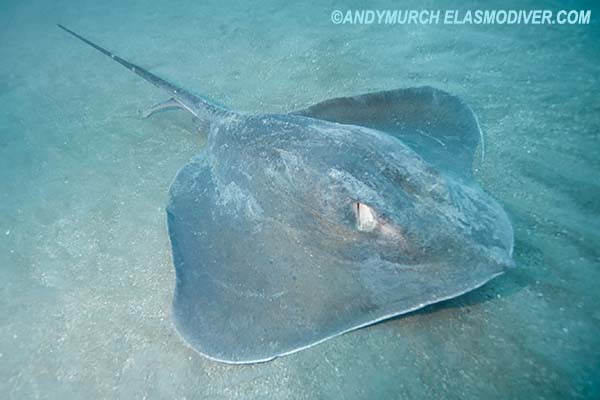
Photograph copyright Andy Murch View all available Roughtail Stingray Pictures in the Shark Pictures Database Roughtail stingray, Roughtail ray, Latin Name: Bathytoshia centroura Family: Dasyatidae Identification: Rhomboid disc with rounded pectoral tips and straight leading edges. Thorns scattered on midline of back and prominent thorns along midline and sides of tail. Tail approx twice body length with deep ventral finfold. Dorsum grey-brown to olive-brown. Ventrum pale. Adults may display a diagonal row of spots from mid pectoral level with eye to just before base of tail. Another parallel row of white spots runs along either side of center-line from mid back to tail. Size: Maximum disc width 220cm. At birth 34-37cm. Habitat: Sand and mud bottoms from intertidal to 275m. Inhabits coastal areas, estuaries, and rivers. Distribution: Western Atlantic - Georges Bank to Florida, Gulf of Mexico, and Uruguay to Southern Brazil. Subtropical; 45°N - 35°S, 90°W - 36°E. Diet: Preys on teleost and cartilaginous fishes, crustaceans, and cephalopods. Reproduction: Ovoviviparous. Gestation about 4 months. Litter size 2 - 6. Breeds annually. Conservation Status: The IUCN lists the Roughtail Stingray as LEAST CONCERN. However, the assessment is out of date and still refers to populations on both sides of the Atlantic. Consequently, the following information should not be relied upon to determine policy. Southwest Atlantic:
This stingray is taken by demersal trawl, gillnets, longlines, and hook and line
(Stehmann 1981). Fishing pressure is intense throughout the range of this
coastal ray and it is considered Vulnerable in Rio de Janeiro Municipality (Buckup
et al. 2000). Brazil has reported among the highest capture production of
elasmobranchs to FAO in recent years (Bonfil et al. 2005). Coastal species are
the most important commercial elasmobranchs in the Southwest Atlantic and
fishing pressure is intense throughout much of the relatively shallow habitat of
this species (Bonfil et al. 2005). Skate and ray landings in the artisanal
fishery in the Rio Grande do Sul, southern Brazil have declined significantly
since the early 1950s (Klippel et al. 2005). One female specimen was recorded in
a year's sampling of the landings of artisanal fleet at Caicara do Norte in
northeastern Brazil (Yokota and Lessa 2006). Like many elasmobranch species,
anecdotal evidence from interviews with fishermen (from Caiçara do Norte, Rio
grande do Norte State, northeastern Brazil) indicate that the D. centroura is
more rarely caught now than previously (L. Yokota pers. comm. 2006). Photographs: Outer Banks, North Carolina, USA. Similar species: The Southern Stingray and Bluntnose Stingray share some of the Roughtail Stingray's range but neither have the telltale thorny tail. Reaction to divers: May be approached with non threatening movements. Diving logistics: Possibly a regular sight on wreck dives on the Outer Banks although I have only seen it once.
Other diving locations submitted by readers: Tim Costikyan wrote: I spotted two roughtail Stingrays off Zach's Beach in Marthas Vinyard in about 8' of water (july 24 2006).
|
|
|
|
SHARK TRIPS |
 |
 |
 |
 |
 |
 |
 |
 |
|
MORE EXPEDITIONS |
 |
 |
 |
 |
 |
 |
 |
 |
 |
 |
 |
 |
|
|
|
SPONSORS |
 |
 |
|
ADVERTISERS |
|
|


|
|
|
ELASMO-BLOGS |
 |
 |
 |
 |
 |