Shark Pictures, Shark Species,  Shark Photography,  Shark Diving, Hot Spots, Shark Taxonomy,  Evolution,  Biology,  Shark Attacks,  Books, Shark Movies,  Articles,  Extinction, Protection, Updates, Site Map, Contact


ELASMODIVER HOME     SHARK PICTURES

underwater photography course

HOME

WHAT'S NEW?

ELASMO-BLOG

SHARK PICTURE LICENSING

SHARK PICTURE PRINTS

PHOTOGRAPHY WORKSHOPS

SHARK DIVING 101

SHARK DIVING HOTSPOTS

FEEDING SHARKS

BASIC SHARK PHOTOGRAPHY

SHARKS UNDER THREAT

ACTIVISTS SAVING SHARKS

SHARK FACTS FOR STUDENTS AND TEACHERS

SHARK ATTACKS

SHARK & RAY TAXONOMY

SHARK & RAY EVOLUTION

SHARK & RAY BIOLOGY

GLOSSARY OF TERMS

SHARK BOOKS

SHARK MOVIES / DOCUMENTARIES

SHARK STORIES AND ARTICLES

SHARK LINKS

ELASMODIVER CONTRIBUTORS

BIO OF ANDY MURCH

SHARK TALK

SITE MAP

CONTACT INFO

SPONSOR ELASMODIVER

ABOUT ELASMODIVER

E-MAIL ELASMODIVER

basking shark picture


Not just Shark Pictures: Elasmodiver contains photos of sharks, skates, rays, and chimaera's from around the world. It began as a simple web based field guide to help divers find the best places to encounter different species of sharks and rays but it has slowly evolved into a much larger project containing information on all aspects of shark diving and photography. There are now more than a thousand shark pictures  and sections on shark evolution, biology, and conservation. There is a large library of reviewed shark books, a constantly outdated shark taxonomy page, a monster list of shark links, and deeper in the site there are numerous articles and stories about shark encounters. Elasmodiver is now so difficult to check for updates, that new information and pictures are listed on an Elasmodiver Updates Page that can be accessed here:

WHAT'S NEW?

Shark picture - green sawfish

_


ELASMODIVER EXPANDED

If you're looking for a broader range of marine life pictures the following links represent a new area that contains pictures on other marine organisms and on marine habitats. This expansion of Elasmodiver is in its first stages but will eventually include pages on everything from sea stars to nudibranches. Creating this portal will take time and for now it consists of a token offering of fish pictures. Please return regularly to enjoy the progress.


FISH PICTURES


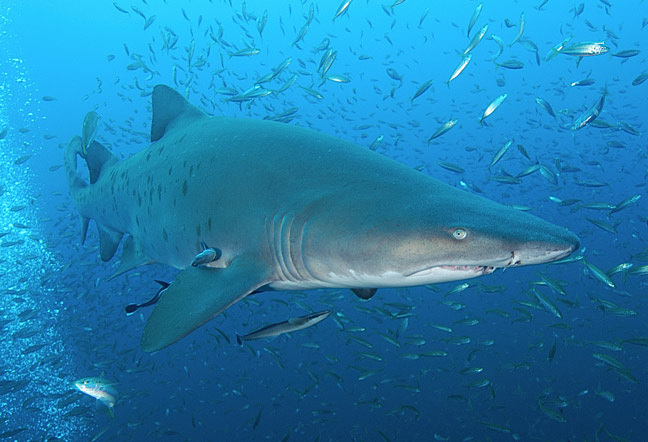
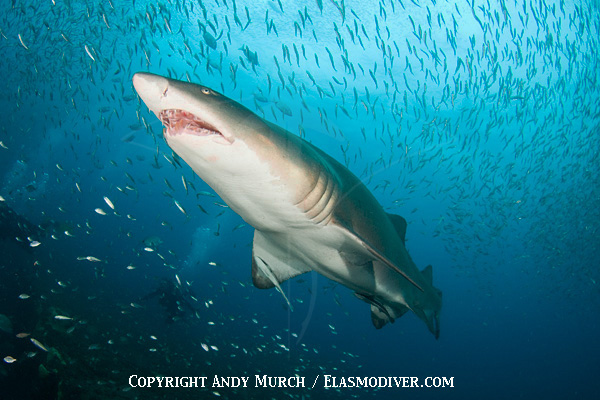
SANDTIGER SHARK


Photograph by Andy Murch. All rights reserved.

Enlarged image         More Sandtiger shark pictures

View all available Sandtiger Shark Pictures in the SHARKIVE

Common Names: Sandtiger shark, Common sandtiger shark, Ragged-tooth shark, Spotted ragged-tooth shark, Raggie, Grey nurse shark, Sand shark.

Latin Name(s): Carcharias taurus, Eugomphodus taurus.

Family: Odontaspididae.

Identification: Exposed ragged appearing teeth in jaw. Nares and upturned snout create a snarling appearance. Bulky mid body. First dorsal fin set far back over pelvic fins. Anal fin large - same size as pelvic fins and second dorsal. Dorsal colouration brown to greyish gold usually with scattered darker spots or blotches. Ventral colouration pale.

Size: Maximum length 2.6m (male), 3.3m (female). Length at birth 1m

Habitat: Found around rocky reefs and wrecks in temperate and tropical waters. From the surface to 200m or more.

Abundance and distribution: A wide ranging coastal species. A frequent inhabitant of shipwrecks on Americas eastern seaboard especially around North Carolina. Also encountered in reef channels around New South Wales (Australia), and at rocky reefs off South Africa. Inhabits deeper water in the Mediterranean. Also commonly seen off Japan. Populations inhabiting higher northern latitudes will move to warmer water in the winter, whilst more tropical groups are often present year round. 

Behavior: Often seen hovering motionless above the bottom. A behaviour achieved by its ability to swim to the surface and swallow air. The stored air allows the shark to float in the same way as a fishes gas filled swim bladder. Although docile the Sandtiger has the ability to lunge forward with great speed when hunting or defensively. Diet varies according to location but generally consists of bony fishes and smaller sharks and rays.

Reproduction: Ovoviviparous and embryophagous i.e. developing embryos practice intrauterine cannibalism until just one baby shark remains in each uterus. Mating aggregations have been observed. Males (in captivity) have been seen to bite females around the gill region to hold on during copulation. Females stop feeding during pregnancy to the point where hydroids have been observed growing on their teeth. 

Observations:

Photographs: North Carolina.

Similar species: Smalltooth sandtiger (Odontaspis ferox). Identified by bulkier conical snout, larger and further forward first dorsal. 

Reaction to divers: Remains motionless unless very closely approached. Not normally aggressive towards divers but males may become more aggessive during courtship.

Diving logistics: Companies out of North Carolinas' Cape Hatteras and Moorhead City run day charters to various wrecks along the Carolina Coast. I have dove repeatedly with John and Amy Pieno who run Outer Banks Diving out of Hatteras and have seen upto 100 Sandtigers on one dive. This was the first dive of the season and the sharks tend to move away from the most visited wrecks as the season progresses but a few are usually still hanging around for a portrait.

Other diving locations submitted by readers:

Further reading:

       Reef Sharks and Rays of the World. Scott W. Michael. Sea Challengers.

       Sharks and Rays - Elasmobranch Guide of the World. Ralf M. Hennemann. IKAN.  

       The Shark Watchers Handbook  - Mark Carwardine and Ken Watterson.

HOME     LINKS     TAXONOMY      UNDER THREAT     BOOKS     CONTACT


SPONSORS

Shark Picture

Shark Diving Hotspots picture
Whats new at elasmodiver picture
Shark Trip article picture
Shark Taxonomy Button
Sharks under Threat picture
Shark Photographers picture
Shark Photography 101 picture