|
|
|
SHARK INFO |
|
SHARK |
|
SHARK EVOLUTION |
|
|
|
SHARK DIVING |
|
SHARK DIVING 101 |
|
|
|
CONSERVATION |
|
|
|
PHOTOGRAPHY |
|
SHARK PHOTO TIPS |
|
|
|
RESOURCES |
|
|
|
WEB STUFF |
|
WHAT IS ELASMODIVER? Not just a huge collection of Shark Pictures: Elasmodiver.com contains images of sharks, skates, rays, and a few chimaera's from around the world. Elasmodiver began as a simple web based shark field guide to help divers find the best places to encounter the different species of sharks and rays that live in shallow water but it has slowly evolved into a much larger project containing information on all aspects of shark diving and shark photography. There are now more than 10,000 shark pictures and sections on shark evolution, biology, and conservation. There is a large library of reviewed shark books, a constantly updated shark taxonomy page, a monster list of shark links, and deeper in the site there are numerous articles and stories about shark encounters. Elasmodiver is now so difficult to check for updates, that new information and pictures are listed on an Elasmodiver Updates Page that can be accessed here:
|
|
_ |
SMOOTH SKATE |
|
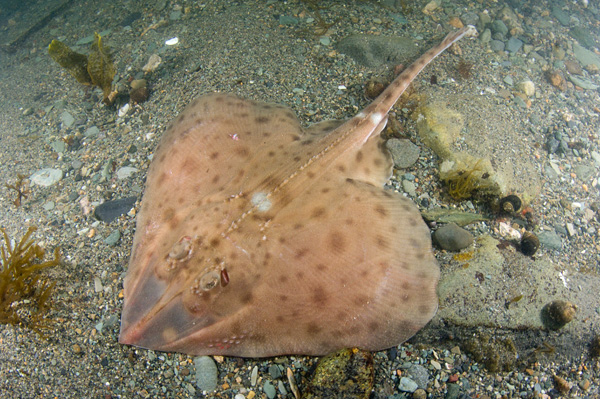
Smooth Skate image © Andy Murch. All rights reserved worldwide.
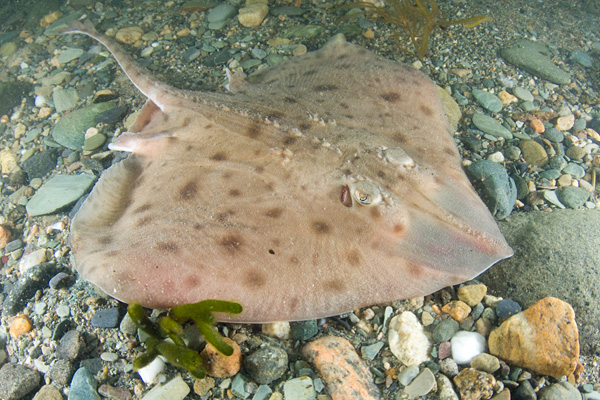
Smooth Skate image © Andy Murch. All rights reserved worldwide.
View all available Smooth Skate Pictures in the shark picture database smooth skate, smooth-tailed skate, thorny skate.
Latin Name: Malacoraja senta Synonyms: Raja senta.
Family: Rajidae
Other Names: Gladde rog Netherlands Dutch, Raie lisse Can Quebec French, Raie lissée France French, Vatos neted Romania Rumanian.
Identification: Disc heart shaped. Disc width and length roughly equal. snout pointed. Rostral cartilage very thin. Tail about half total length. Dorsum mostly smooth. A single distinct row of thorns extends along centre line of back and tail. Tail thorns diminish in adults and are virtually invisible in older male specimens. Thorns also on centre-line of snout, around eyes, and a small cluster on each side of mid line behind head and on the anterior margin of the disc close to the rostral cartilage. Dorsum light brown to grey with irregular scattered dark blotches. Dark ringed white blotch midway along centre line of back. One or two dark edged white bands along tail. White blotches and bands fade in adulthood. Ventrum pale with a few indistinct pale spots.
Size: Maximum length 61cm.
Habitat: The smooth skate can be found on soft mud and clay bottoms as well as sandy, broken shell and gravel substrates. From 25 to 1436 meters but usually found between 70 and 480 meters. Tolerates moderately low salinity environments in the Gulf of St Lawrence. Smaller specimens tend to be found at deeper depths.
Abundance and distribution: Smooth skates inhabit a relatively small area in the western North Atlantic Ocean from Newfoundland to New Jersey. They are found in the inshore waters of the St Lawrence river estuary to deep offshore banks but they do not occur evenly throughout that range and are probably confined to a handful of deep troughs separated by shallower banks. The Laurentian Channel in the Gulf of St. Lawrence, southwest Grand Bank, Flemish Cap, northeast Newfoundland Shelf and the Labrador Shelf have all been identified as containing sub populations of smooth skates.
Diet: Smooth skates have an extremely rigid diet of mostly small crustaceans. Large adults occasionally consume small benthic fishes. The diet of smooth skates may be a contributing factor in their narrow range.
Reproduction: Oviparous. Smooth skate egg capsules are deposited on sand and mud bottoms. Egg cases range in size from 5 to 5.9 cm in length. They are rectangular in shape with hardened pointed corners. Studies of mature collected specimens indicate that smooth skates may be sexually active throughout the year. Females mature at 4154 cm total length (TL) and between 89.5 years of age, and males mature at 4957 cm TL and between 8 and 10 years of age.
Vulnerability: The smooth skate is assessed 'endangered' in Canadian waters and 'near threatened' in US waters by the IUCN. Although this species is not the focus of a directed fishery it is caught in trawling/dredging operations targeting other benthic fishes and invertebrates. Surveys indicate that the abundance of the smooth skate has declined by 73% to 91% (depending on the region) over a 29 year period. Despite a reduction in ground fishing efforts and although smooth skates are a 'no take' species, biomass of the two main sub-populations in Canadian waters have not recovered at all in the last two decades. The US sub-populations are also very close to being classed as over fished.
Photographs: Kings Beach, Rhode Island. Specimen released from bycatch collected while trawling for squid. Images were made possible through the cooperation of Brian Raymond.
Similar species: There are a number of other skates inhabiting this region. The barndoor skate has a vaguely similar shape but a much more acutely pointed snout. Winter and little skates have blunter snouts and smaller spots.
Reaction to divers: Swims away and resettles when closely approached.
Diving logistics: The smooth skate generally inhabits depths exceeding normal diving limits.
Encounters reported by divers:
Further reading: http://www.fishbase.com http://www.nefsc.noaa.gov/sos/spsyn/op/skate/ |
|
|
|
SHARK TRIPS |
 |
 |
 |
 |
 |
 |
 |
 |
|
MORE EXPEDITIONS |
 |
 |
 |
 |
 |
 |
 |
 |
 |
 |
 |
 |
|
|
|
SPONSORS |
 |
 |
|
ADVERTISERS |
|
|


|
|
|
ELASMO-BLOGS |
 |
 |
 |
 |
 |