|
|
|
SHARK INFO |
|
SHARK |
|
SHARK EVOLUTION |
|
|
|
SHARK DIVING |
|
SHARK DIVING 101 |
|
|
|
CONSERVATION |
|
|
|
PHOTOGRAPHY |
|
SHARK PHOTO TIPS |
|
|
|
RESOURCES |
|
|
|
WEB STUFF |
|
WHAT IS ELASMODIVER? Not just a huge collection of Shark Pictures: Elasmodiver.com contains images of sharks, skates, rays, and a few chimaera's from around the world. Elasmodiver began as a simple web based shark field guide to help divers find the best places to encounter the different species of sharks and rays that live in shallow water but it has slowly evolved into a much larger project containing information on all aspects of shark diving and shark photography. There are now more than 10,000 shark pictures and sections on shark evolution, biology, and conservation. There is a large library of reviewed shark books, a constantly updated shark taxonomy page, a monster list of shark links, and deeper in the site there are numerous articles and stories about shark encounters. Elasmodiver is now so difficult to check for updates, that new information and pictures are listed on an Elasmodiver Updates Page that can be accessed here:
|
|
_ |
SOUTHERN BAT RAY |
|
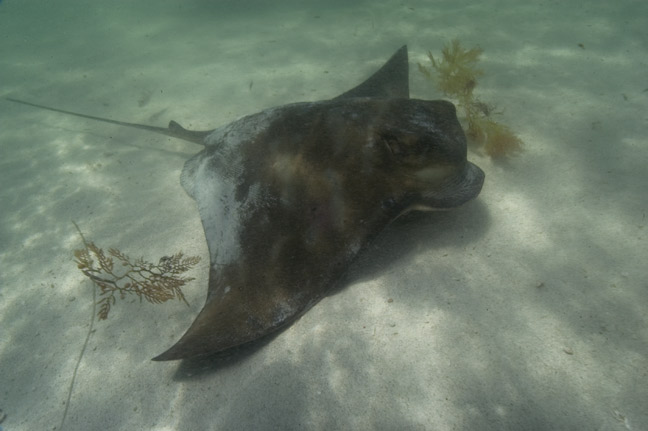
Photograph copyright Andy Murch all rights reserved View all available Southern Bat Ray Pictures in the Shark Pictures Database Southern bat ray, Southern eagle ray. Latin Name: Myliobatis australis Family: Myliobatididae Identification: Pectoral fins narrow and pointed. Subrostral lobe (beak) short and rounded. Dorsum brown with pale blue blotches. Size: Wing span to 150cm. Habitat: Bays, rocky and coral reef faces, and sand flats (where it feeds). Abundance and distribution: New Zealand and Australia (from Queensland around the southern coast to W.A.) Behavior: Often found resting in sand in excavated depressions. Forages in the sand for shelled mollusks and crabs but will take fish incidentally as shown by the bat rays at Hamelin Bay (See diving logistics). Reproduction: Ovoviviparous. Observations: Photographs: Hamelin Bay, W.Australia. Similar species: The New Zealand eagle ray (M.tenuicaudatus) is possibly the same species. Reaction to divers: Usually difficult to approach except at Hamelin Bay. See Below. Diving logistics:
By far the best spot to see and photograph Southern bat rays is Hamelin Bay in
W.Australia. Here the presence of scraps in the water has resulted in these and
other ray species becoming desensitized to contact with humans. Waders and
snorkellers are able to feed the rays right from shore. Noone appears to have
been hurt in this activity and the rays that come in to take advantage of the
snacks are able to be petted and hand fed.
Other diving locations submitted by readers: Further reading: Reef Sharks and Rays of the World. Scott W. Michael. Sea Challengers. Sharks
and Rays - Elasmobranch Guide of the World. Ralf M. Hennemann. IKAN.
|
|
|
|
SHARK TRIPS |
 |
 |
 |
 |
 |
 |
 |
 |
 |
 |
 |
 |
|
MORE EXPEDITIONS |
 |
 |
 |
 |
 |
 |
 |
 |
 |
 |
 |
|
|
|
|
|
SPONSORS |
 |
 |
 |
|
ADVERTISERS |
|
|


|
|
|
ELASMO-BLOGS |
 |
 |
 |
 |
 |