Shark Pictures, Shark Species,  Shark Photography,  Shark Diving, Hot Spots, Shark Taxonomy,  Evolution,  Biology,  Shark Attacks,  Books, Shark Movies,  Articles,  Extinction, Protection, Updates, Site Map, Contact


ELASMODIVER HOME     SHARK PICTURES

underwater photography course

HOME

WHAT'S NEW?

ELASMO-BLOG

SHARK PICTURE LICENSING

SHARK PICTURE PRINTS

PHOTOGRAPHY WORKSHOPS

SHARK DIVING 101

SHARK DIVING HOTSPOTS

FEEDING SHARKS

BASIC SHARK PHOTOGRAPHY

SHARKS UNDER THREAT

ACTIVISTS SAVING SHARKS

SHARK FACTS FOR STUDENTS AND TEACHERS

SHARK ATTACKS

SHARK & RAY TAXONOMY

SHARK & RAY EVOLUTION

SHARK & RAY BIOLOGY

GLOSSARY OF TERMS

SHARK BOOKS

SHARK MOVIES / DOCUMENTARIES

SHARK STORIES AND ARTICLES

SHARK LINKS

ELASMODIVER CONTRIBUTORS

BIO OF ANDY MURCH

SHARK TALK

SITE MAP

CONTACT INFO

SPONSOR ELASMODIVER

ABOUT ELASMODIVER

E-MAIL ELASMODIVER

basking shark picture


Not just Shark Pictures: Elasmodiver contains photos of sharks, skates, rays, and chimaera's from around the world. It began as a simple web based field guide to help divers find the best places to encounter different species of sharks and rays but it has slowly evolved into a much larger project containing information on all aspects of shark diving and photography. There are now more than a thousand shark pictures  and sections on shark evolution, biology, and conservation. There is a large library of reviewed shark books, a constantly outdated shark taxonomy page, a monster list of shark links, and deeper in the site there are numerous articles and stories about shark encounters. Elasmodiver is now so difficult to check for updates, that new information and pictures are listed on an Elasmodiver Updates Page that can be accessed here:

WHAT'S NEW?

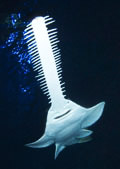
Shark picture - green sawfish

_


ELASMODIVER EXPANDED

If you're looking for a broader range of marine life pictures the following links represent a new area that contains pictures on other marine organisms and on marine habitats. This expansion of Elasmodiver is in its first stages but will eventually include pages on everything from sea stars to nudibranches. Creating this portal will take time and for now it consists of a token offering of fish pictures. Please return regularly to enjoy the progress.


FISH PICTURES


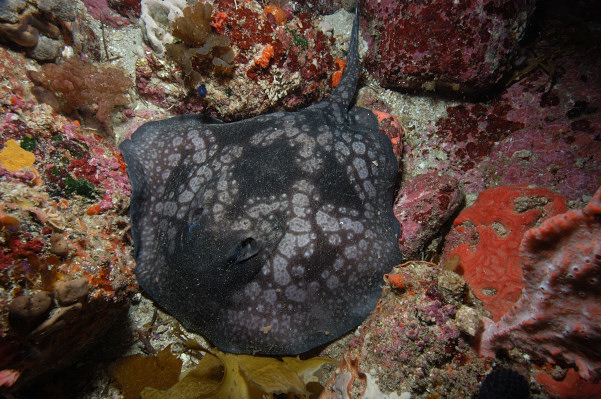
SPOTTED STINGAREE


Photograph copyright Andy Murch

View more Spotted Stingaree Pictures in the SHARKIVE

Common Names: Spotted stingaree

Latin Name: Urolophus gigas

Family: Urolophidae

Identification: Disc round without prominent point on snout. Roughly circular, light grey, broken spots create a pattern  covering most of the black or darker dorsum. Usually dark in front of eyes, and centrally behind eyes extending into two dark patches on real half of pectoral fins. Pattern of spots extends along tail. Two color forms from the eastern and western range may be distinct species. Sinclair's stingaree (urolophus sp.) may be the western color form, a  juvenile of the U. gigas, or a distinct species.

Size: Maximum length approx 70cm.

Habitat: 2 - 50m. Often seen buried in sandy sea grass areas. The specimen above was deeply hidden under a rocky reef.

Abundance and distribution: Southern Australia, from Victoria and Northern Tasmania to at least Albany, WA. 

Behavior: Buries during the day.

Reproduction: Ovoviviparous.

Observations:  

Photographs: Albany, Western Australia.

Similar species: Circular stingaree - Urolophus circularis shares its western range. A rarely encountered species exibiting a distinct pattern of circular spots similar to U. gigas and Urolophus sp. but without their dark bat-shaped patches.

Reaction to divers: The specimen above completely ignored the photographer but this species may be more skittish when encountered in the open.  

Diving logistics: Divers usually encounter this species while swimming over sea grass beds. Anywhere in the southern Australian area is probably good for sightings. As I have only encountered this specimen in WA I would like information on common sighting areas further east.

Other diving locations submitted by readers:

References and further reading:

Sharks and Rays of Australia. Peter Last. CSIRO.

Reef Sharks and Rays of the World. Scott W. Michael. Sea Challengers.

Sharks and Rays - Elasmobranch Guide of the World. Ralf M. Hennemann. IKAN.

 HOME     LINKS     TAXONOMY     BOOKS     CONTACT


SPONSORS

Shark Picture

Shark Diving Hotspots picture
Whats new at elasmodiver picture
Shark Trip article picture
Shark Taxonomy Button
Sharks under Threat picture
Shark Photographers picture
Shark Photography 101 picture