|
|
|
SHARK INFO |
|
SHARK |
|
SHARK EVOLUTION |
|
|
|
SHARK DIVING |
|
SHARK DIVING 101 |
|
|
|
CONSERVATION |
|
|
|
PHOTOGRAPHY |
|
SHARK PHOTO TIPS |
|
|
|
RESOURCES |
|
|
|
WEB STUFF |
|
WHAT IS ELASMODIVER? Not just a huge collection of Shark Pictures: Elasmodiver.com contains images of sharks, skates, rays, and a few chimaera's from around the world. Elasmodiver began as a simple web based shark field guide to help divers find the best places to encounter the different species of sharks and rays that live in shallow water but it has slowly evolved into a much larger project containing information on all aspects of shark diving and shark photography. There are now more than 10,000 shark pictures and sections on shark evolution, biology, and conservation. There is a large library of reviewed shark books, a constantly updated shark taxonomy page, a monster list of shark links, and deeper in the site there are numerous articles and stories about shark encounters. Elasmodiver is now so difficult to check for updates, that new information and pictures are listed on an Elasmodiver Updates Page that can be accessed here:
|
|
_ |
|
TASSELED WOBBEGONGS IN WESTERN AUSTRALIA
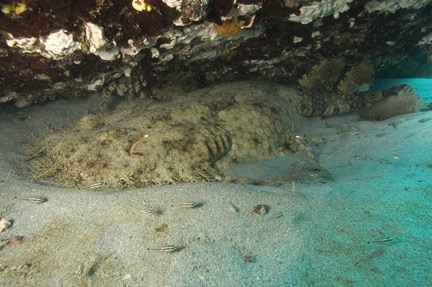
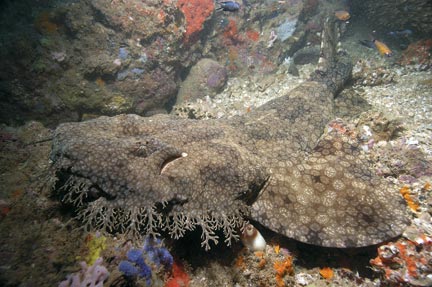
They say that Perth way down in Western Australia, is the remotest city in the world. If this is true then Exmouth which is a twenty hour drive north of Perth must be the remotest town. It’s a long way for sure, but I’d go ten times that distance if I thought I could see a crazy looking shark I hadn’t photographed yet. Exmouth is bordered by the Ningaloo Reef which is famous for seasonal Whale shark sightings. Whale sharks are pretty high on most divers hit lists but I’m a self confessed weird shark junky and I’m here to look for Tasseled wobbegongs. Even in such a strange looking family of sharks, Tasseled wobbegongs are freaks. There are presently seven recognized species of “wobbies”, and at least three more waiting to be described. All have skin flaps protruding from around their mouths and elaborate patterns on their backs that help them disappear when snuggled in between the surrounding corals. But, the most bizarre looking family member is the Tasseled wobbegong that sports an entire fringe of branching skin flaps running around its head from one pectoral fin to the other. So good is this camouflage that it can become almost completely invisible on the reef. Leaving Perth I couldn’t wait to see my first Tasseled wobbie. I spent the night driving north and arrived at high noon in the scorching heat of tropical W.A. The first thing you notice about Exmouth is the Emus. They wander the streets like 6ft tall giant chickens. I decided I was going to like this oasis in the otherwise featureless scrub and dodging the emus I sauntered off to the dive shop. Exmouth Diving Centre hooked me up with a dive under the navy pier where Tasseled wobbies often congregate. We had to go through a series of military checkpoints to reach the structure but finally we drove onto the jetty itself and plunged in. The action under the pier was intense. Writhing balls of baitfish swept from one end to the other trying to avoid the tunas, jacks, and Grey reef sharks that assaulted them from all directions. I stationed myself on the sand right in the middle of the bombardment but there was so much movement that the bottom was constantly stirred up and I was forced off to the side to avoid being ‘bumped’ by the hungry sharks. It was an unexpected treat and I simply hovered unobtrusively enjoying the show until my escort Steve ‘Gibbo’ Gibson tugged me on the arm and dragged me off to find the wobbies. We swam between the pilings searching the ground and then abruptly Gibbo stopped swimming and pointed to a nondescript pile of rocks. I looked at the rocks and then up at Steve, and then back at the rocks. He could see I looked puzzled so he swam down and pointed a bit closer at one protruding rock feature. Adjusting my brain I noticed that the rock he was pointing at had gills. Finally realizing that I was about 2ft in from a Tasseled wobbegong’s head I back pedaled a little bit and swung my camera into position between me and the wobbie’s very well camouflaged mouth. Wobbies will strike at anything that falls in front of their mouths including a poorly placed hand or fin. The skin flaps around a Tasseled wobbie’s jaw look rather like a refuge to small vulnerable fishes. However, as soon as an unsuspecting fish wanders too close, the wobbie explodes forward at breakneck speed, while at the same time pulling its jaws apart to reveal rows of razor sharp fangs. This action literally sucks the fish into its mouth from where its needle-like teeth ensure there is no escape. I was ecstatic to finally see this bizarre looking shark sitting motionless in front of me and I snapped away to my hearts content. Wobbies don’t like to be out in the open and most of this one was obscured by fallen rocks and debris so we wandered on looking for a better positioned individual. We came across three more on this dive and more again on subsequent visits. All of them were adult size and none made any attempt at all to hide or flee. That’s my kind of shark, I could have set up a tripod if I’d had one. Although, most of the time wobbies remain completely motionless relying on their camouflage, on occasion they can get quite aggressive, lunging at unsuspecting scuba divers and leaving serious puncture wounds. Usually this is the result of abuse from aggressive divers man handling them or invading their personal space. But, unprovoked attacks do occur. One diver on Blizzard Ridge (not far from Exmouth Lighthouse) was leisurely swimming along when a Tasseled wobbie rose from its resting place, bit him on the stomach, and settled back into its original position. Hey, even wobbies can have a bad day. By the time I left Exmouth I was hooked on these sharks that look like swimming reefs with teeth. Next time I return I guess I’ll schedule my visit for whale shark season but secretly I’ll be back to see the wobbies. Back
to Elasmodiver Trip Reports
Elasmodiver Home
|
|
|
|
SHARK TRIPS |
 |
 |
 |
 |
 |
 |
 |
 |
|
MORE EXPEDITIONS |
 |
 |
 |
 |
 |
 |
 |
 |
 |
 |
 |
 |
|
|
|
SPONSORS |
 |
 |
|
ADVERTISERS |
|
|


|
|
|
ELASMO-BLOGS |
 |
 |
 |
 |
 |