|
|
|
SHARK INFO |
|
SHARK |
|
SHARK EVOLUTION |
|
|
|
SHARK DIVING |
|
SHARK DIVING 101 |
|
|
|
CONSERVATION |
|
|
|
PHOTOGRAPHY |
|
SHARK PHOTO TIPS |
|
|
|
RESOURCES |
|
|
|
WEB STUFF |
|
WHAT IS ELASMODIVER? Not just a huge collection of Shark Pictures: Elasmodiver.com contains images of sharks, skates, rays, and a few chimaera's from around the world. Elasmodiver began as a simple web based shark field guide to help divers find the best places to encounter the different species of sharks and rays that live in shallow water but it has slowly evolved into a much larger project containing information on all aspects of shark diving and shark photography. There are now more than 10,000 shark pictures and sections on shark evolution, biology, and conservation. There is a large library of reviewed shark books, a constantly updated shark taxonomy page, a monster list of shark links, and deeper in the site there are numerous articles and stories about shark encounters. Elasmodiver is now so difficult to check for updates, that new information and pictures are listed on an Elasmodiver Updates Page that can be accessed here:
|
|
_ |
THORNBACK SKATE |
|
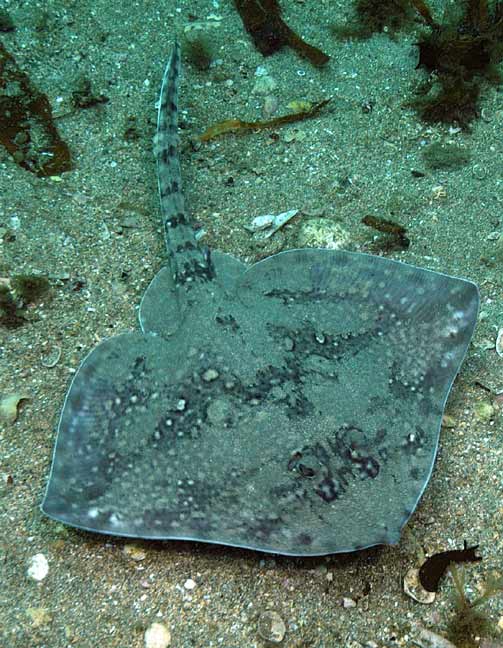
View all available Thornback Skate Pictures in the Shark Pictures Database Thornback skate, Thornback ray (UK). Latin Name: Raja clavata Family: Rajidae Identification: Rounded snout gives way to mildly concave anterior margins of pectoral fins. Distinct nub at tip of snout. Posterior margins of pectoral fins slightly convex. Small and large thorns extend down back and tail. Pattern of irregular sized pale spots and light and dark patches cover dorsum. Overal colouration may be grey or brown. Size: Maximum length 90cm Habitat: Found on sand and mud bottoms occasionally adjacent to rocky reefs. Intertidal to 300m. Abundance and distribution: Common in eastern Atlantic from Norway south throughout the Mediterranean, the western Baltic, and the western Black Sea. Behavior: Usually seen lying motionless on sand. Forages for a variety of benthic animals such as crustaceans. Reproduction: Oviparous. Large females may lay upto 150 egg capsules during one season. Observations: Photographs: Helford River, Cornwall, UK. Similar species: Reaction to divers: Docile. Remains motionless unless closely approached. A slow swimmer unless threatened. I followed one specimen for 20 minutes along the river bed occasionally getting close enough to snap pictures. Diving logistics: There are probably many places where it is possible to shore dive with Thornback skates. In southern Corwall around April the estuary of the Helford river is a good place to try. For convenience Porthkerris Divers can drop you in the middle of the river which is only about 10m deep. The tide will then carry you in or out of the river mouth. It is best to choose an incoming tide when the water is clearest. It is also possible to gain entry from the shore to this same area but the incoming tide may mean that exiting in the same spot is tricky. Other diving locations: Further reading: Sharks and Rays - Elasmobranch Guide of the World. Ralf M. Hennemann. IKAN. |
|
|
|
SHARK TRIPS |
 |
 |
 |
 |
 |
 |
 |
 |
|
MORE EXPEDITIONS |
 |
 |
 |
 |
 |
 |
 |
 |
 |
 |
 |
 |
|
|
|
SPONSORS |
 |
 |
|
ADVERTISERS |
|
|


|
|
|
ELASMO-BLOGS |
 |
 |
 |
 |
 |