Shark Pictures   

Shark & Ray Field Guide   

   shark diving and whale diving and humboldt squid encounters 


HOME

THE FIELD GUIDE

SHARK PICTURES

WHAT'S NEW?

SHARK BLOG

MERCHANDISE

SHARK TRIPS

SITE MAP

E-MAIL


EXPEDITIONS
Humboldt squid diving and diving with sperm whales and fin whales.
Oceanic Whitetip Diving at Cat Island, Bahamas.


SHARK & RAY FIELD GUIDE

SHARK PICTURES

DAILY SHARK PIC

BUY PRINTS

BASIC SHARK PHOTOGRAPHY

PHOTOGRAPHY WORKSHOPS

PROJECT DEEP SHARK

SHARK DIVING

SHARK DIVING EXPEDITIONS

SHARK DIVING 101

SHARK DIVING HOTSPOTS

DIVE OPERATOR DIRECTORY

SHARK DIVING STORIES

FEEDING SHARKS

SHARK ATTACKS

THE SHARK TOUR

CONSERVATION

SHARKS UNDER THREAT

PREDATORS IN PERIL

ACTIVISTS SAVING SHARKS

SHARK BIOLOGY

SHARK FACTS FOR KIDS

SHARK & RAY BIOLOGY

SHARK & RAY TAXONOMY

SHARK & RAY EVOLUTION

GLOSSARY OF TERMS

RESOURCES

SHARK NEWS

SHARK LINKS

SHARK BOOKS

SHARK MOVIES & DOCUMENTARIES

WEB STUFF

 ADVERTISE

CONTACT INFO

ABOUT ELASMODIVER

SHARK TALK

ELASMODIVER CONTRIBUTORS

BIO OF ANDY MURCH

 
 ELASMOBRANCHS

Not just Shark Pictures: Elasmodiver contains photos of sharks, skates, rays, and chimaera's from around the world. It began as a simple web based field guide to help divers find the best places to encounter different species of sharks and rays but it has slowly evolved into a much larger project containing information on all aspects of shark diving and photography. There are now more than a thousand shark pictures  and sections on shark evolution, biology, and conservation. There is a large library of reviewed shark books, a constantly outdated shark taxonomy page, a monster list of shark links, and deeper in the site there are numerous articles and stories about shark encounters. Elasmodiver is now so difficult to check for updates, that new information and pictures are listed on an Elasmodiver Updates Page that can be accessed here:

WHAT'S NEW?

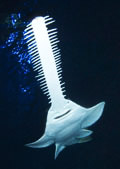
Shark picture - green sawfish

_

SHARK FOOD?

ELASMODIVER EXPANDED

If you're looking for a broader range of marine life pictures the following links represent a new area of elasmodiver.com that contains pictures of other marine organisms and of marine habitats. This expansion of Elasmodiver is in its first stages but will eventually include pages on all types of marine mammals, bony fishes and marine invertebrates as well as coastal habitats, reefscapes and other imagess relating to the ocean. Please return regularly to enjoy the progress.


IMAGE PAGES

CRAB PICTURES
CROCODILEPICTURES
DOLPHIN PICTURES

FISH PICTURES

LOBSTER PICTURES

MARINE PICTURES

OCTOPUS PICTURES

SEALION PICTURES

SHARK PICTURES

SHELL PICTURES

SHRIMP PICTURES


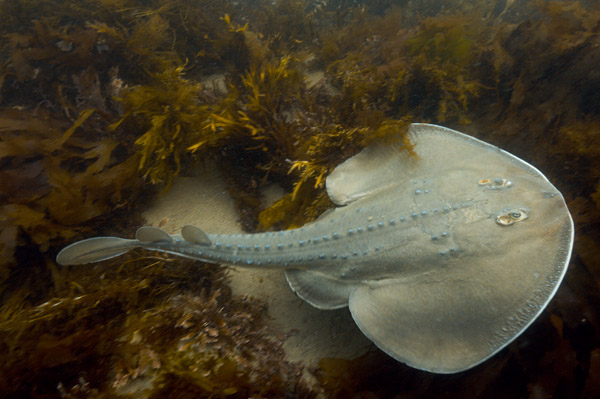
THORNBACK RAY


View all available Thornback Ray Pictures

Common English Names:

Thornback Ray, Thornback Guitarfish.

Latin Name: Platyrhinoidis triseriata.

Family: Platyrhinidae - containing 3 genera and 5 described species. Morphologically thornback rays fall somewhere between guitarfishes and torpedo rays and may represent the evolutionary link between the two families.

Identification: Rounded disc slightly wider than long with rounded anterior edge which has a thin white margin. Three pronounced rows of tubercles (spines) run along back and tail from behind eyes. Tail broad with two well developed, rounded dorsal fins of roughly equal size set close to caudal fin. Oval caudal fin small. Dorsum uniformly light brown to grey. Ventrum pale. Two separate rostral cartilages extend from the skull to the tip of the snout which differentiates thornback rays from guitarfishes which have only one.

Size: Maximum length 91cm.

Habitat: Intertidal Inshore waters to 50m. On sand and mud bottoms and occasionally in or around kelp beds.

Abundance and distribution: Central California to Baja.

Behavior: During the day lays partially buried in sand. Forages for worms, molluscs and crustaceans in the substrate. May be solitary or in groups.

Reproduction: Thornback rays are ovoviviparous (yolk sac viviparity). One species is said to be oviparous laying skate egg shaped cases but this needs to be confirmed.

Photographs: Tajegis Beach, Santa Barbara, California.

Similar species: There is only one thornback ray living in this region. The closest sympatric species is the Banded Guitarfish which is easily identifiable by its bold markings and longer, more shark-like tail.

Reaction to divers: Generally easy to approach with slow movements. I was able to follow the photographed specimen for most of a dive as it slowly swam around the reef.

Diving logistics: Apparently a common species in many bays in southern California but it is often in turbid inshore water where photography is difficult. Try hunting in shallow bays just beyond the surf line for the best chance at sightings.

Other diving locations submitted by readers:

Further reading:

Sharks, Rays, and Chimaeras of California. David A. Ebert

Reef Sharks and Rays of the World. Scott W. Michael. Sea Challengers.

Sharks and Rays - Elasmobranch Guide of the World. Ralf M. Hennemann. IKAN.

HOME     LINKS     TAXONOMY      UNDER THREAT     BOOKS     CONTACT


EXPEDITIONS
Humpback whale diving and manta diving in Socorro.
Sharkfest Sandtiger Shark Diving
Tiger shark diving at Tiger Beach, Bahamas.
 
SPONSORS
 
ADVERTISERS

 
ELASMO-BLOGS


shark diving and photography expeditions


IF YOU LIKE THIS PAGE PLEASE SHARE IT Share


SharkPictures   Shark & Ray Field Guide   SharkPhotography   SharkDiving   Taxonomy   Evolution   Biology   SharkAttacks   Books   Shark Movies   Stories   Extinction   Protection   Updates   SiteMap


CONTACT ELASMODIVER

elasmodiver@gmail.com

250-588-8267

P.O.Box 8719 Station Central, Victoria, BC., V8W 3S3, Canada