|
|
|
SHARK INFO |
|
SHARK |
|
SHARK EVOLUTION |
|
|
|
SHARK DIVING |
|
SHARK DIVING 101 |
|
|
|
CONSERVATION |
|
|
|
PHOTOGRAPHY |
|
SHARK PHOTO TIPS |
|
|
|
RESOURCES |
|
|
|
WEB STUFF |
|
WHAT IS ELASMODIVER? Not just a huge collection of Shark Pictures: Elasmodiver.com contains images of sharks, skates, rays, and a few chimaera's from around the world. Elasmodiver began as a simple web based shark field guide to help divers find the best places to encounter the different species of sharks and rays that live in shallow water but it has slowly evolved into a much larger project containing information on all aspects of shark diving and shark photography. There are now more than 10,000 shark pictures and sections on shark evolution, biology, and conservation. There is a large library of reviewed shark books, a constantly updated shark taxonomy page, a monster list of shark links, and deeper in the site there are numerous articles and stories about shark encounters. Elasmodiver is now so difficult to check for updates, that new information and pictures are listed on an Elasmodiver Updates Page that can be accessed here:
|
|
_ |
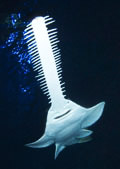
VELEZ RAY |
|
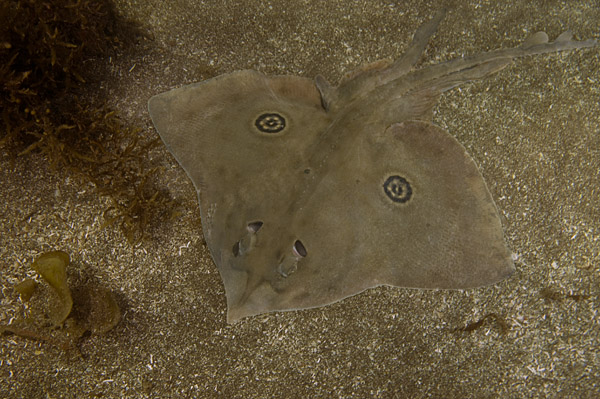
Velez ray / rasptail skate image © Andy Murch. All rights reserved worldwide.
View all available Velez Skate Pictures in the shark picture database velez skate, velez ray, rasptail skate, rasptail ray, thorny skate.
Latin Name: Raja velezi
Family: Rajidae
Other Names:
Identification: Disc width about 1.3 x length. Snout pointed. In males, anterior margin of disc convex with distinct concavity about widway towards wing tips. In females, anterior margin of disc is much straighter. Posterior margin of disc rounded. Dorsum mid to dark brown. Prominent light yellowish/tan occelli with two concentric dark rings, on each wing. Patch of thorns on each side of snout, level with eyes, close to disc margin. Centre line of thorns runs from behind the eyes to the tip of the tail. Tail also has prominent rows of thorns on each side running from base to tip - hence common name 'rasptail ray/skate'.
Size: Maximum length 75.6cm.
Habitat: The velez skate can be found on sand bottoms and gravel substrates. From 35 to 300 meters but usually found between 35 and 140 meters.
Abundance and distribution: The velez ray can be found in the Eastern Pacific from the Gulf of California to Peru including the Galapagos Islands.
Diet: Crustaceans, polychaete worms and small benthic fishes. In Columbia, the main prey item of the velez skate was shown to be tiger shrimp but fish were also heavily consumed
(Feeding ecology of elasmobranch fishes in coastal waters of
the Colombian Eastern Tropical Pacific
Andrés F Navia,
 1,2
Paola A Mejía-Falla,1,2 and Alan Giraldo2
- 2007) 1,2
Paola A Mejía-Falla,1,2 and Alan Giraldo2
- 2007)
Reproduction: Oviparous. Little is known about the velez ray's reproductive cycle.
Vulnerability: The IUCN is unable to estimate the catch trend or vulnrability due to the deficiency of available data. However, the IUCN does provide this footnote: Raja velezi is known to be taken in shrimp trawl fisheries operating off Colombia, and is probably captured by trawl and other demersal fisheries operating throughout its range. The shrimp trawl fishery off Colombia operates from the shelf to depths of at least 300 m and this species is a retained bycatch of this fishery (Puentes et al. 2007). I have personally witnessed velez skates being taken as bycatch by artisanal shark fishermen in La Paz, Mexico. The fishermen released this skate and told me that it was not a commercially sought after species.
Photographs: Sea of Cortez, La Paz Bay, Baja, Mexico. Composite image.
Similar species: There are a number of other skates inhabiting this region. In the Sea of Cortez, the velez ray shares its range with R. cortezensis, R. equatorialis, Raja inornata and R. rhina
Reaction to divers: This skate does not inhabit depths frequented by recreational divers.
Diving logistics: N/A.
Encounters reported by divers:
Further reading: http://www.fishbase.com http://www.iucnredlist.org/apps/redlist/details/161344/0 |
|
|
|
SHARK TRIPS |
 |
 |
 |
 |
 |
 |
 |
 |
|
MORE EXPEDITIONS |
 |
 |
 |
 |
 |
 |
 |
 |
 |
 |
 |
 |
|
|
|
SPONSORS |
 |
 |
|
ADVERTISERS |
|
|


|
|
|
ELASMO-BLOGS |
 |
 |
 |
 |
 |