|
|
|
SHARK INFO |
|
SHARK &
RAY FIELD GUIDE |
|
SHARK
PICTURE DATABASE |
|
SHARK TAXONOMY |
|
SHARK
BIOLOGY |
|
SHARK
EVOLUTION |
|
SHARK FACTS FOR KIDS
|
|
|
|
SHARK
DIVING |
|
SHARK
DIVING EXPEDITIONS |
|
SHARK
DIVING 101 |
|
SHARK
DIVING HOTSPOTS |
|
SHARK
DIVING STORIES |
|
SHARK
FEEDING ADVICE |
|
SHARK
ATTACKS |
|
|
|
CONSERVATION |
|
SHARKS
UNDER THREAT |
|
PREDATORS
IN PERIL |
|
|
|
PHOTOGRAPHY |
|
SHARK
PHOTO TIPS |
|
DAILY SHARK IMAGES |
|
|
|
RESOURCES |
|
SHARK NEWS
|
|
SHARK
LINKS |
|
SHARK
BOOKS |
|
SHARK
FILMS |
|
SHARK
TERMS |
|
|
|
WEB STUFF |
|
CONTACT
ELASMODIVER |
|
ABOUT ELASMODIVER |
|
ANDY MURCH
ELASMO GEEK |
|
WHAT IS ELASMODIVER?
Not just a
huge collection of
Shark
Pictures:
Elasmodiver.com contains images of sharks, skates, rays, and a few
chimaera's from around the world. Elasmodiver began as a simple web
based
shark
field guide
to help divers find the best places to encounter the different
species of sharks and rays that live in shallow water but it has
slowly evolved into a much larger project containing information on
all aspects of shark diving and shark photography.
There are
now more than 10,000 shark pictures and sections on shark
evolution, biology, and conservation. There is a large library of
reviewed shark books, a constantly updated shark taxonomy page, a
monster list of shark links, and deeper in the site there are
numerous articles and stories about shark encounters. Elasmodiver is
now so difficult to check for updates, that new information and
pictures are listed on an Elasmodiver Updates Page that can be
accessed here:
WHAT'S NEW?
 |
|
_ |
| |
|
ELASMOBRANCH LOCOMOTION |
|
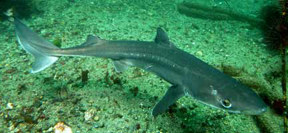 Shark
locomotion
Sharks have fairly immobile pectoral fins that do
not aid in locomotion but serve in guidance and add lift in the same manner as
airplane wings. All of a classic shaped shark’s forward propulsion comes
from the rhythmic sine wave that is created by its body snaking through the
water. The back and forth motion of its head creates areas of high and low
pressure which the rest of its body slips into. Its tail fin gives the final
flick from within this low-pressure space allowing the shark to slide through
the water with the minimum possible effort. Shark
locomotion
Sharks have fairly immobile pectoral fins that do
not aid in locomotion but serve in guidance and add lift in the same manner as
airplane wings. All of a classic shaped shark’s forward propulsion comes
from the rhythmic sine wave that is created by its body snaking through the
water. The back and forth motion of its head creates areas of high and low
pressure which the rest of its body slips into. Its tail fin gives the final
flick from within this low-pressure space allowing the shark to slide through
the water with the minimum possible effort.
|
|
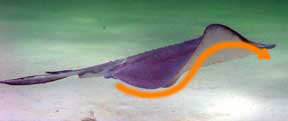 Ray
locomotion
- Rays and skates spend much of their time lying motionless on the seafloor or
riverbed. Their tails are in many instances vestigial and in certain species
non-existent. Although stingray and skate pectoral fins are attached along their
entire basal length, their outer margins are highly flexible. This flexibility
allows them to roll their pectoral fins through the water either backwards or
forwards. The ray is then propelled backward or forward on this pressure wave.
At full speed this movement is accentuated from a fin ripple into a flapping
motion. The Eagle, Manta and Mobula rays employ this flapping motion all the
time. Electric
rays, guitarfish, and sawfish, have retained
more "shark
like" streamlined bodies. They use
tail propulsion for forward momentum and often use their pectoral fins
to stand above the substrate. This stance probably allows them to accelerate
forward more quickly. Electric rays also have the ability to hop forward
on their pelvic fins. Ray
locomotion
- Rays and skates spend much of their time lying motionless on the seafloor or
riverbed. Their tails are in many instances vestigial and in certain species
non-existent. Although stingray and skate pectoral fins are attached along their
entire basal length, their outer margins are highly flexible. This flexibility
allows them to roll their pectoral fins through the water either backwards or
forwards. The ray is then propelled backward or forward on this pressure wave.
At full speed this movement is accentuated from a fin ripple into a flapping
motion. The Eagle, Manta and Mobula rays employ this flapping motion all the
time. Electric
rays, guitarfish, and sawfish, have retained
more "shark
like" streamlined bodies. They use
tail propulsion for forward momentum and often use their pectoral fins
to stand above the substrate. This stance probably allows them to accelerate
forward more quickly. Electric rays also have the ability to hop forward
on their pelvic fins.
|
|
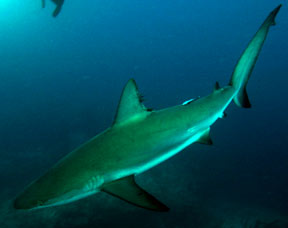 Sink
or swim. Fish sink. Fish are denser than the water around them and
therefore need help to stay motionless in the water column. The bony fishes
have solved this problem by evolving a swim bladder. This is a gas filled
chamber in their bodies that makes them neutrally buoyant. Sharks and rays do
not have this swim bladder but possess a highly enlarged, oil filled liver.
Whilst their livers are less efficient than swim bladders for maintaining
neutral buoyancy, they have the advantage that they can make fast vertical
migrations through the water column without having to try to equalize
gasses. The trade off however is that the majority of sharks have to
swim forward relying on the lift this creates to maintain their depth. As
sharks age their girth often increases proportionately more than their length
and fin size. Having a greater mass requires a proportionately greater still
amount of oil. To this end large mature sharks have
extremely
large livers. Sink
or swim. Fish sink. Fish are denser than the water around them and
therefore need help to stay motionless in the water column. The bony fishes
have solved this problem by evolving a swim bladder. This is a gas filled
chamber in their bodies that makes them neutrally buoyant. Sharks and rays do
not have this swim bladder but possess a highly enlarged, oil filled liver.
Whilst their livers are less efficient than swim bladders for maintaining
neutral buoyancy, they have the advantage that they can make fast vertical
migrations through the water column without having to try to equalize
gasses. The trade off however is that the majority of sharks have to
swim forward relying on the lift this creates to maintain their depth. As
sharks age their girth often increases proportionately more than their length
and fin size. Having a greater mass requires a proportionately greater still
amount of oil. To this end large mature sharks have
extremely
large livers.
|
|
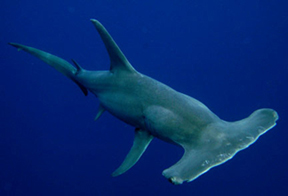 The pectoral fins
in many families of sharks are
ideally shaped to add lift. The ocean going Hammerheads that are often
considered the most highly evolved of open ocean sharks have taken this science
one stage further with the hydrodynamic shape of their heads. Scientists now
believe that this trait is primarily designed for lift but their widened heads
may also serve to better triangulate their electro-receptors spaced across the
snout and also aid in pinning prey (stingrays) to the seabed.
A major repercussion of this constantly swimming lifestyle is that water
is
naturally flushed over the gills. Therefore water pumping musculature
which is present in less active species is underdeveloped in open ocean
sharks hindering their ability to rest should the opportunity or necessity
present itself. The pectoral fins
in many families of sharks are
ideally shaped to add lift. The ocean going Hammerheads that are often
considered the most highly evolved of open ocean sharks have taken this science
one stage further with the hydrodynamic shape of their heads. Scientists now
believe that this trait is primarily designed for lift but their widened heads
may also serve to better triangulate their electro-receptors spaced across the
snout and also aid in pinning prey (stingrays) to the seabed.
A major repercussion of this constantly swimming lifestyle is that water
is
naturally flushed over the gills. Therefore water pumping musculature
which is present in less active species is underdeveloped in open ocean
sharks hindering their ability to rest should the opportunity or necessity
present itself.
|
|
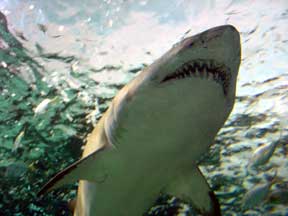 Sandtiger
sharks
(Odontaspidae) have developed
their own solution to the problem of negative buoyancy. These sharks appear to
levitate in mid water apparently defying gravity. In order to do this sandtigers
swallow air at the surface counteracting their tendency to sink. This solution
allows them to hover near the reef without expending energy. Less energy
expenditure equals less time spent hunting. This docile behavior has made
sandtigers popular in public aquariums where they seem content to remain static
without bumping the glass. Sandtiger
sharks
(Odontaspidae) have developed
their own solution to the problem of negative buoyancy. These sharks appear to
levitate in mid water apparently defying gravity. In order to do this sandtigers
swallow air at the surface counteracting their tendency to sink. This solution
allows them to hover near the reef without expending energy. Less energy
expenditure equals less time spent hunting. This docile behavior has made
sandtigers popular in public aquariums where they seem content to remain static
without bumping the glass.
|
|
Turbulence
is a major factor in the quest for speed. All objects disturb the medium
through which they pass. In air this a minor consideration at most speeds but
in water which is 800 times denser than air the turbulence created is enough
to slow a moving object to a crawl. As in air, when an object moves
increasingly faster the drag increases at a compound rate until a speed is
reached where the force required to increase the speed any further becomes impractical.
The fusiform bodies of sharks are designed to cut cleanly through the water
but body shape alone does not explain some sharks ability to exceed all
expectations based on a size to speed ratio. So how do large sharks such as
the Mako attain speeds fast enough to catch a tuna? The answer lies in the
dermal denticles that are imbedded in the sharks skin. Incredibly, the
skin of many sharks has evolved to channel the water smoothly along the
sharks body without creating back eddies or waves which the shark would have
to push against. These minute channels known as riblets are so efficient at
reducing drag that racing yachts have successfully employed the same
technology to shorten their times.
|
| |
|