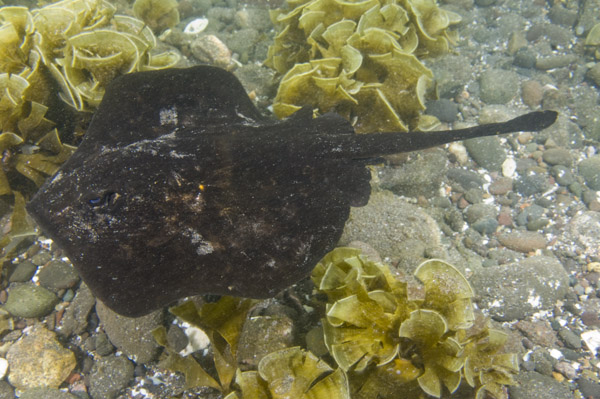
Male round stingray during the mating season. Mulege, Baja, Mexico. Note blue eyes.
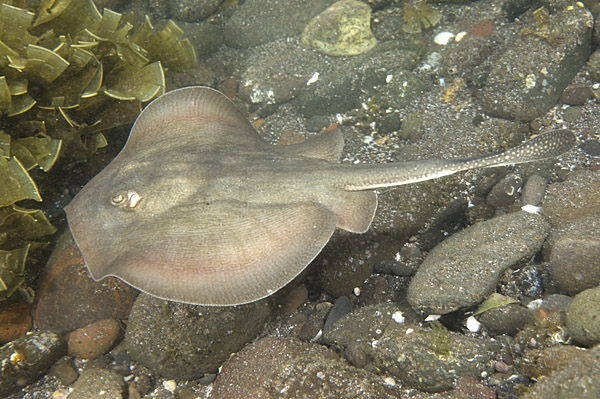
Sub
adult round stingray, Mulege, Baja, Mexico.
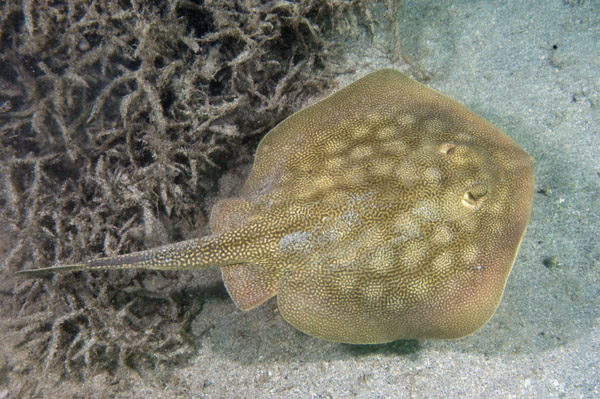
Round
stingray displaying golden spots and reticulations. Playa El Burro, Baja.
All photographs copyright Andy Murch.
All rights reserved worldwide.
View all available
Hallers Round Stingray Pictures in the
Shark Pictures Database
Common Names: Round stingray, Haller's
round stingray.
Latin Name:
Urobatis halleri.
Family:
Urobatidae.
Identification:
Circular disc, no dorsal fin, tail shorter than disc
length, sting present on tail. Dorsum smooth (no tubercles). Colour highly
variable: golden yellow, pinkish grey, light or dark brown or completely black.
Often pale with a covering pattern of small dark spots and/or reticulated lines reversing
in color towards the tail. Ventrum generally pale but
yellow or dark near the disc margin on dark individuals. Eyes generally golden
but may appear blue in very old animals. Blueness probably caused by a rheumy
film rather than an an actual change in pigmentation.
Size:
Maximum length 56cm.
Habitat:
Intertidal to 90m on sand or mud sometimes around reefs.
Abundance:
Maybe locally abundant in shallow bays in the
Sea of Cortez. Commonly encountered resting/foraging in the surf zone in
Southern California.
Distribution:
Northern California to Costa Rica and possibly
south to Peru. Recent discovery of a separate species (Urobatis pardalis)
present between Costa Rica and Columbia may be responsible for sightings within
that area.
Behavior:
Probably nocturnal. Lays
motionless during the day. Digs for worms and crustaceans at night.
Reproduction:
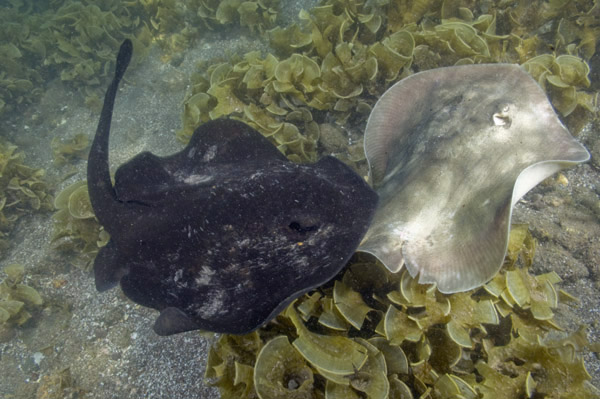
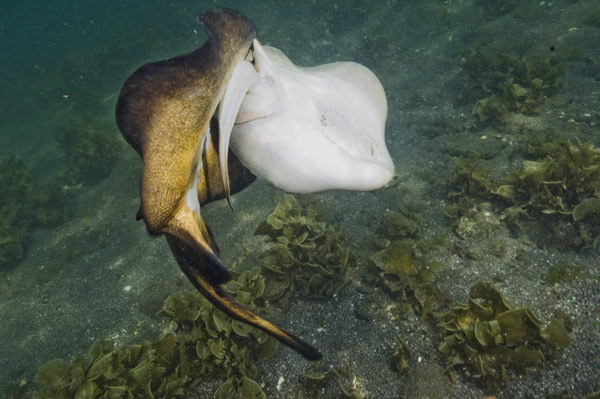
Ovoviviparous. Male
grasps female from behind and attempts to subdue her and turn her over to mate.
See images below:
Conservation Stutus:
Hallers round stingray has been assessed as
'Least Concern' by the IUCN. It is not fished commercially, but is occasionally
taken by recreational fishers and by artisanal fisheries. This species is also
likely taken incidentally by Mexican shrimp trawlers, but the extent of this
practice is not well known and no species-specific information is documented.
When caught in artisanal fisheries it is generally discarded and its small size
and large tail spine make it an undesirable target species. However, in Mexico,
the tail is usually cleaved off before it is returned to the sea, which may
result in high mortality of discards (Bizzarro, pers. comm). This species
matures after 2.6 years with a biannual reproductive cycle, making it a
relatively productive batoid. As the species is generally abundant where it
occurs, is productive, and as there are no major threats apparent (particularly
there are little threats to the species in southern California where is it very
abundant) it is assessed as Least Concern.
Photographs:
Muleje and Playa El Burro, Sea of Cortez.
Similar species:
Haller's round stingray shares its range with a
handful of similar round stingrays. In the Gulf of California
the Cortez round stingray is
similar but with conspicuous
scattered dark
blotches on a pale dorsum. The bullseye round stingray
lacks spots but displays similar diffuse concentric rings.
In
Costa Rica, the leopard round stingray shares many visual traits but generally
displays larger spots and vermiculations.
Reaction to divers:
Sometimes difficult to approach in the surf zone in
California but easily observed in the Sea of Cortez where they are extremely
abundant.
Older animals tend to move a bit slower and tolerate closer observation.
Diving logistics:
MEXICO - in the shallow bays of Baja, these rays are sometimes so
abundant that safely wading through the shallows without running the risk of
treading on a round stingray is almost impossible. Some of the places that I have seen round stingrays
in great numbers are off the beach Bahia de los Angeles, off the
town beach in Mulege (near the lighthouse) and off Playa El Burro a few kms to the
south. All of the beaches in this region are probably good.
CALIFORNIA - La Jolla Shores is a great place for observing all manner of
elasmobranchs. During the summer months, the shallows are often crowded with
leopard sharks, soupfin sharks, shovelnose guitarfish and plenty of haller's
stingrays. The latter tend to favour the surf line so waders should use caution
when walking in the shallows.
Citations:
Ebert, D.A. 2006. Urobatis halleri. The IUCN Red List of
Threatened Species 2006: e.T60108A12302610. http://dx.doi.org/10.2305/IUCN.UK.2006.RLTS.T60108A12302610.en