Shark Pictures, Shark Species,  Shark Photography,  Shark Diving, Hot Spots, Shark Taxonomy,  Evolution,  Biology,  Shark Attacks,  Books, Shark Movies,  Articles,  Extinction, Protection, Updates, Site Map, Contact


ELASMODIVER HOME     SHARK PICTURES

underwater photography course

HOME

WHAT'S NEW?

ELASMO-BLOG

SHARK PICTURE LICENSING

SHARK PICTURE PRINTS

PHOTOGRAPHY WORKSHOPS

SHARK DIVING 101

SHARK DIVING HOTSPOTS

FEEDING SHARKS

BASIC SHARK PHOTOGRAPHY

SHARKS UNDER THREAT

ACTIVISTS SAVING SHARKS

SHARK FACTS FOR STUDENTS AND TEACHERS

SHARK ATTACKS

SHARK & RAY TAXONOMY

SHARK & RAY EVOLUTION

SHARK & RAY BIOLOGY

GLOSSARY OF TERMS

SHARK BOOKS

SHARK MOVIES / DOCUMENTARIES

SHARK STORIES AND ARTICLES

SHARK LINKS

ELASMODIVER CONTRIBUTORS

BIO OF ANDY MURCH

SHARK TALK

SITE MAP

CONTACT INFO

SPONSOR ELASMODIVER

ABOUT ELASMODIVER

E-MAIL ELASMODIVER

basking shark picture


Not just Shark Pictures: Elasmodiver contains photos of sharks, skates, rays, and chimaera's from around the world. It began as a simple web based field guide to help divers find the best places to encounter different species of sharks and rays but it has slowly evolved into a much larger project containing information on all aspects of shark diving and photography. There are now more than a thousand shark pictures  and sections on shark evolution, biology, and conservation. There is a large library of reviewed shark books, a constantly outdated shark taxonomy page, a monster list of shark links, and deeper in the site there are numerous articles and stories about shark encounters. Elasmodiver is now so difficult to check for updates, that new information and pictures are listed on an Elasmodiver Updates Page that can be accessed here:

WHAT'S NEW?

Shark picture - green sawfish

_


ELASMODIVER EXPANDED

If you're looking for a broader range of marine life pictures the following links represent a new area that contains pictures on other marine organisms and on marine habitats. This expansion of Elasmodiver is in its first stages but will eventually include pages on everything from sea stars to nudibranches. Creating this portal will take time and for now it consists of a token offering of fish pictures. Please return regularly to enjoy the progress.


FISH PICTURES


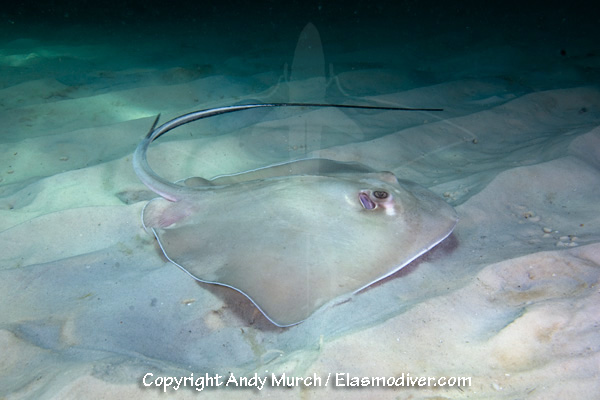
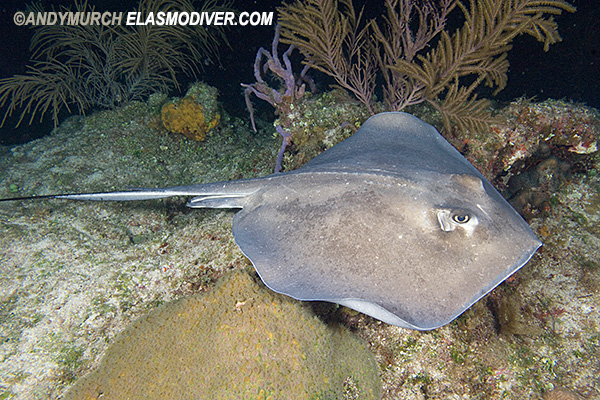
SOUTHERN STINGRAY


Photograph copyright Andy Murch

Enlarged image     More Southern Stingray photographs

View all available Southern Stingray Pictures in the SHARKIVE

Common Names: Southern stingray.

Latin Name: Dasyatis americana.

Family: Dasyatidae.

Identification: Rhomboid disc. Deep ventral tail finfold. Row of tubercles running from base of head to partway along tail. Two much shorter rows of tubercles visible behind eyes. One or two stinging spines present on base of tail. Dorsal surface uniform brown to gray often darkening slightly near margin of disc. Ventral surface white.

Size: Maximum disc width 1.5m.

Habitat: Intertidal to 25m. Inhabits sandy areas and reefs.

Abundance: Common in Florida and Northern Caribbean waters. Sightings less frequent in its broader range.

Distribution: Florida and Caribbean, also north to New Jersey and south to Brazil.

Behavior: Often seen by divers sleeping or cruising over sand patches near reefs, stopping occasionally to dig for animals in the sand. Eats a variety of small fish, mollusks and crustaceans. Lies at rest covered by sand with just eyes protruding. If stepped on by a diver or attacked by its natural predator the hammerhead shark, it will sting over its head like a scorpion.

Reproduction: Ovoviviparous.

Observations: These stingrays are easily conditioned to accept the presence of hundreds of humans. At Stingray Sandbar on Grand Cayman, I observed the daily feeding ritual where large boats bring hoards of tourists to swim and snorkel with the rays. There is one unsubstantiated report from 2001 in which a large hammerhead ventured into this busy scene and plucked a stingray out from amongst the screaming tourists.

Photographs: Grand Cayman.

Similar species: The Caribbean stingray (Himantura schmarde) shares its Caribbean range with the Southern stingray but is easily distinguished by its oval disc.

Reaction to divers: Remain motionless unless closely molested

Diving Logistics: This is such a commonly sighted species near reefs that it is unnecessary to describe specific opportunities to dive in its presence. However Stingray City in Grand Cayman probably has the greatest opportunities for any diver to interact with and photograph Southern Stingrays. Whilst working on the island as a submersible pilot I was lucky enough to have access to this site on numerous occasions. Upon entering the water here, and at the shallower Stingray Sandbar (for snorkellers), the diver is immediately surrounded by silky skinned rays that rub past you nuzzling with their mouths in search of a handout.

Other diving locations submitted by readers:

HOME     LINKS     TAXONOMY     BOOKS     CONTACT


SPONSORS

Shark Picture

Shark Diving Hotspots picture
Whats new at elasmodiver picture
Shark Trip article picture
Shark Taxonomy Button
Sharks under Threat picture
Shark Photographers picture
Shark Photography 101 picture