|
|
|
SHARK INFO |
|
SHARK |
|
SHARK EVOLUTION |
|
|
|
SHARK DIVING |
|
SHARK DIVING 101 |
|
|
|
CONSERVATION |
|
|
|
PHOTOGRAPHY |
|
SHARK PHOTO TIPS |
|
|
|
RESOURCES |
|
|
|
WEB STUFF |
|
WHAT IS ELASMODIVER? Not just a huge collection of Shark Pictures: Elasmodiver.com contains images of sharks, skates, rays, and a few chimaera's from around the world. Elasmodiver began as a simple web based shark field guide to help divers find the best places to encounter the different species of sharks and rays that live in shallow water but it has slowly evolved into a much larger project containing information on all aspects of shark diving and shark photography. There are now more than 10,000 shark pictures and sections on shark evolution, biology, and conservation. There is a large library of reviewed shark books, a constantly updated shark taxonomy page, a monster list of shark links, and deeper in the site there are numerous articles and stories about shark encounters. Elasmodiver is now so difficult to check for updates, that new information and pictures are listed on an Elasmodiver Updates Page that can be accessed here:
|
|
_ |
WINTER SKATE |
|
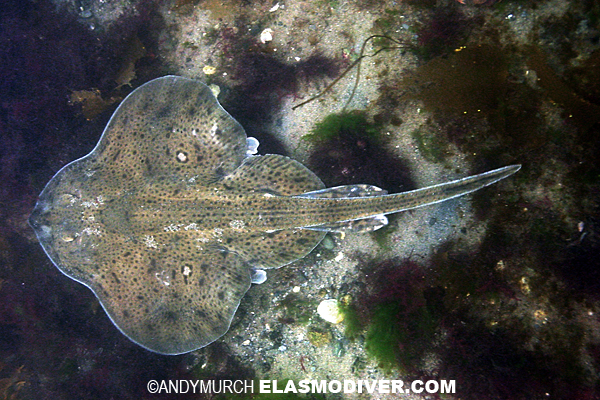
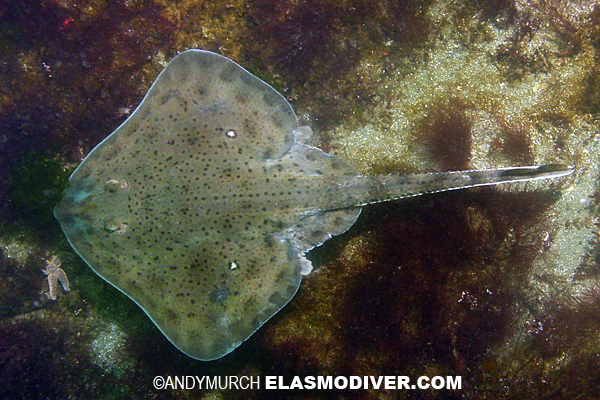
Male Winter Skate
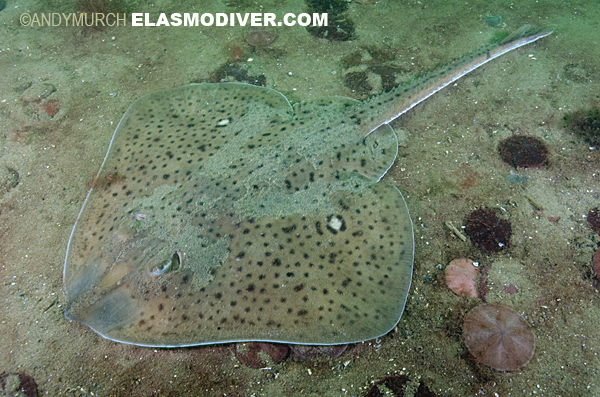
Female Winter Skate Winter skate, Big skate, Spotted skate, Eyed skate. Latin Names: Raja ocellata, Leucoraja ocellata Family: Rajidae Identification: Rhomboid disc. Anterior disc margin blunter than a right angle bulging opposite the eyes. Bluntly rounded snout, more concave towards the blunt pectoral fin tips. Anterior surface tan or brown to gray with a pattern of dark spots. 1 to 4 white eyespots may be present towards the rear of the pectoral fins. This feature is the best way to differentiate this skate from the little skate at a glance. A band of alar thorns are generally present around the snout and eyes, along the disc margins (broadening towards the posterior edge), and along the tail where they are more pronounced. The central line of the tail is free of thorns. In adult males the claspers trail halfway down the tail length. Positive identification (when eyespots are missing) can only be made by counting teeth (72 to 110 in each jaw, 38 to 66 in the Little skate). Size: 30" to 34" Maximum 42". At 32" long the disc width is approximately 20" Habitat: Sandy slopes sometimes adjacent to rocky reefs. From intertidal to 600ft. Most common around 200ft but easily found in shallower areas. Abundance and distribution: Western Atlantic, from Newfoundland to North Carolina. Common along the New England coastline. Behavior: The Winter skate comes closer to shore in the cooler months, in the southern part of its range. Diurnal, lays motionless partially covered in sand during the day. Forages for rock crabs and squid at night, as well as annelid worms, amphipods, shrimps, and razor clams. Will also eat fish when available. Reproduction: Oviparous. Lays oval egg capsules (known as mermaids purses) with 4 pointed corners that it attaches to rocks and seaweed with sticky tendrils. Reproduction takes place in summer and fall. Observations: Whilst watching these skates swimming close to the sand, they appeared to use a pointed section on the outer portions of their pelvic fins to pull themselves along. I have not read of this so it may be just a finning action. Please let me know if anyone can confirm this. Photographs: Back Beach and Kettle Island, Cape Ann peninsula, Massachusetts. Similar species: Little skate Raja erinacea Reaction to divers: Skittish but will allow slow approach. Diving logistics: A great place to find this skate in the summer months is Back Beach outside of Rockport, Cape Ann, Mass. A shore dive here is very easy and the pebble beach increases visibility. Dive flag required by state law. Air can be obtained from Cape Ann Divers who are also very knowledgeable about dives in the area and can supply directions to other shore diving and organize charters.
References: Fishes of the Gulf of Maine Bigelow and Schroeder. |
|
|
|
SHARK TRIPS |
 |
 |
 |
 |
 |
 |
 |
 |
|
MORE EXPEDITIONS |
 |
 |
 |
 |
 |
 |
 |
 |
 |
 |
 |
 |
|
|
|
SPONSORS |
 |
 |
|
ADVERTISERS |
|
|


|
|
|
ELASMO-BLOGS |
 |
 |
 |
 |
 |