|
|
|
SHARK INFO |
|
SHARK |
|
SHARK EVOLUTION |
|
|
|
SHARK DIVING |
|
SHARK DIVING 101 |
|
|
|
CONSERVATION |
|
|
|
PHOTOGRAPHY |
|
SHARK PHOTO TIPS |
|
|
|
RESOURCES |
|
|
|
WEB STUFF |
|
WHAT IS ELASMODIVER? Not just a huge collection of Shark Pictures: Elasmodiver.com contains images of sharks, skates, rays, and a few chimaera's from around the world. Elasmodiver began as a simple web based shark field guide to help divers find the best places to encounter the different species of sharks and rays that live in shallow water but it has slowly evolved into a much larger project containing information on all aspects of shark diving and shark photography. There are now more than 10,000 shark pictures and sections on shark evolution, biology, and conservation. There is a large library of reviewed shark books, a constantly updated shark taxonomy page, a monster list of shark links, and deeper in the site there are numerous articles and stories about shark encounters. Elasmodiver is now so difficult to check for updates, that new information and pictures are listed on an Elasmodiver Updates Page that can be accessed here:
|
|
_ |
LITTLE SKATE |
|
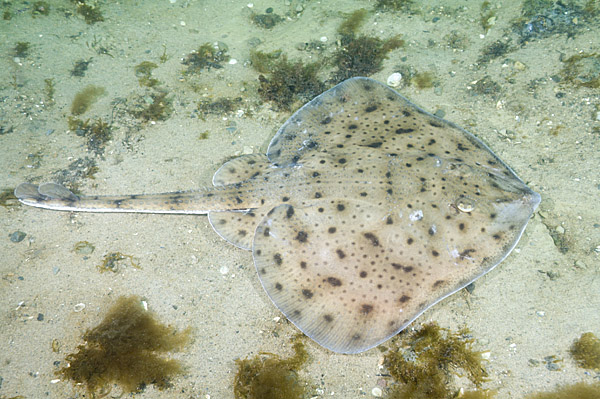
Little Skate female
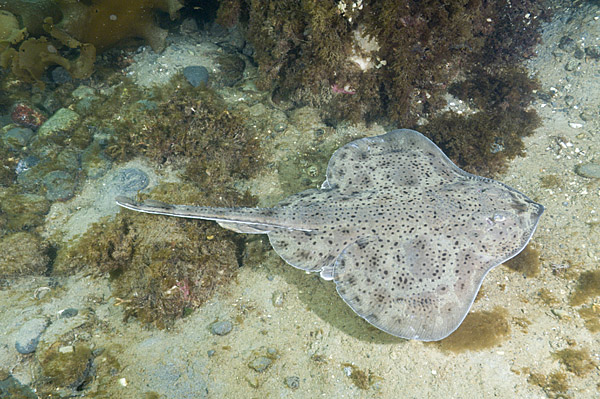
Little Skate male View all available Little Skate Pictures in the shark picture database Little Skate, Little Common Skate, Little Summer Skate. Latin Name: Leucoraja erinacea Other Names:
Family: Rajidae Identification: Rounded snout with pointed central tip. Mildly concave anterior margins of pectoral fins. Concavity appears to be more prominent in males. Posterior margins of pectoral fins rounded. Small thorns extend down centre line of back and tail and run across the margin of the snout. Dorsal pattern includes regular sized dark spots (polka dots) and larger less frequent dark spots. Overall coloration grey to brown. Underlying color may be solid or consist of large rounded patches. No distinct occeli present on pectoral fins Size: Maximum length 54cm Habitat: Found on sand, gravel and mud bottoms occasionally adjacent to rocky reefs. Intertidal to 329m but mostly above 90m. Abundance and distribution: North western Atlantic Ocean from the St Lawrence River in Canada to North Carolina. Behavior: Usually seen lying motionless on sand. Forages for a variety of benthic animals such as crustaceans. Reproduction: Oviparous. 10-35 egg capsules laid annually. Photographs: Cape Ann Peninsula, Massachusetts. Similar species: Winter Skate (Raja ocellata) identifiable by the distinct ocelli (circular black and white eye-like markings) on the pectoral fins. Reaction to divers: Docile. Remains motionless on the sand unless closely approached. A slow swimmer unless threatened. Once alerted to the presence of divers, the little skate usually swims away slowly but makes the occasional dash followed by a very quick settling in the seabed. In the process a lot of sand is disturbed which confuses the pursuer as to the skates whereabouts. This strategy is similar to the way an octopus releases ink as a decoy. Diving logistics: There is a dive site off of Back Beach in Rockport on the Cape Ann Peninsula, Massachusetts, where Little Skates can be seen at certain times of year. I have encountered them there in September but earlier in the summer the same area was inhabited by Winter Skates. Diving off Back Beach is a simple matter of walking in off the beach and kicking out while keeping a close eye on the sand. Occasionally skates rest on top of the kelp in which case they are far easier to spot. Other diving locations: Further reading: http://www.fishbase.com |
|
|
|
SHARK TRIPS |
 |
 |
 |
 |
 |
 |
 |
 |
|
MORE EXPEDITIONS |
 |
 |
 |
 |
 |
 |
 |
 |
 |
 |
 |
 |
|
|
|
SPONSORS |
 |
 |
|
ADVERTISERS |
|
|


|
|
|
ELASMO-BLOGS |
 |
 |
 |
 |
 |