|
|
|
SHARK INFO |
|
SHARK |
|
SHARK EVOLUTION |
|
|
|
SHARK DIVING |
|
SHARK DIVING 101 |
|
|
|
CONSERVATION |
|
|
|
PHOTOGRAPHY |
|
SHARK PHOTO TIPS |
|
|
|
RESOURCES |
|
|
|
WEB STUFF |
|
WHAT IS ELASMODIVER? Not just a huge collection of Shark Pictures: Elasmodiver.com contains images of sharks, skates, rays, and a few chimaera's from around the world. Elasmodiver began as a simple web based shark field guide to help divers find the best places to encounter the different species of sharks and rays that live in shallow water but it has slowly evolved into a much larger project containing information on all aspects of shark diving and shark photography. There are now more than 10,000 shark pictures and sections on shark evolution, biology, and conservation. There is a large library of reviewed shark books, a constantly updated shark taxonomy page, a monster list of shark links, and deeper in the site there are numerous articles and stories about shark encounters. Elasmodiver is now so difficult to check for updates, that new information and pictures are listed on an Elasmodiver Updates Page that can be accessed here:
|
|
_ |
STARRY SKATE |
|
View all available Starry Skate Pictures in the shark picture database starry skate, prickly skate, rock skate, Pacific starry skate.
Latin Name: Raja stellulata Pseudonym: Raja montereyensis
Family: Rajidae
Other Names:
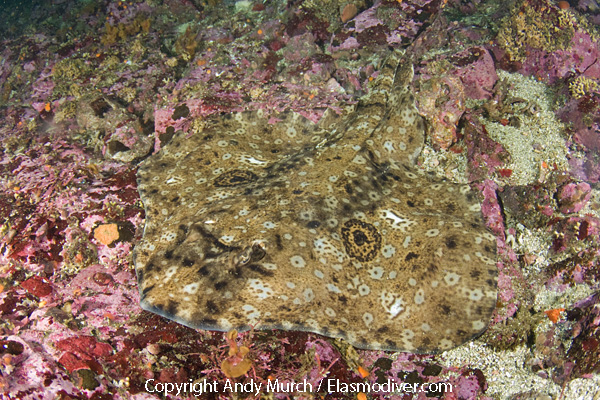
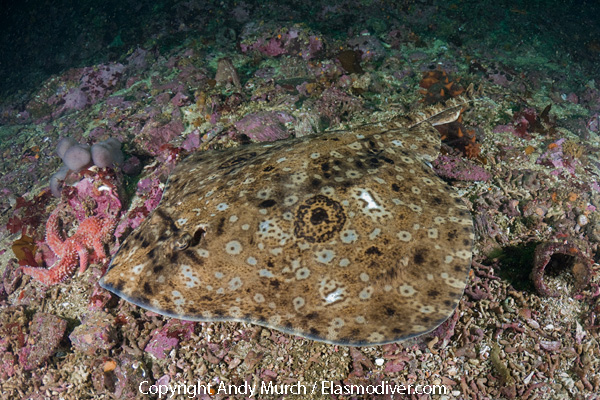
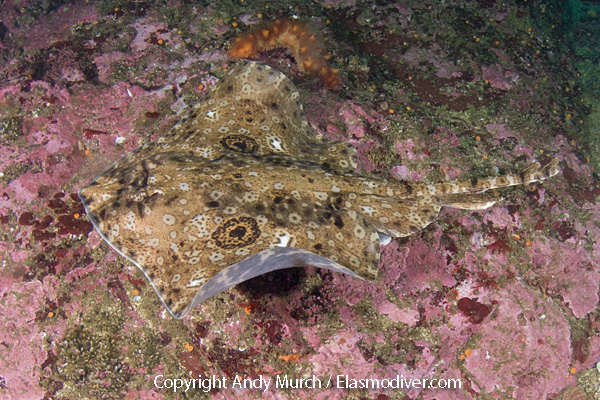
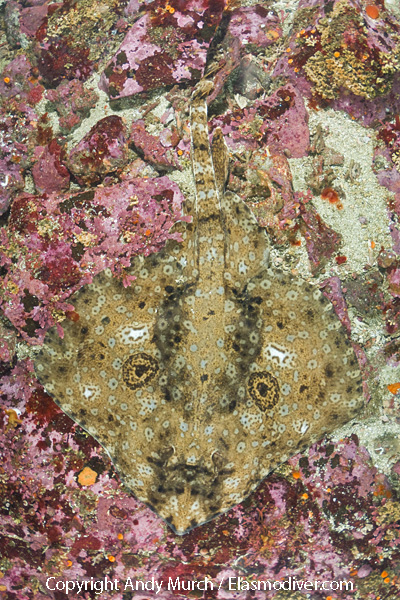
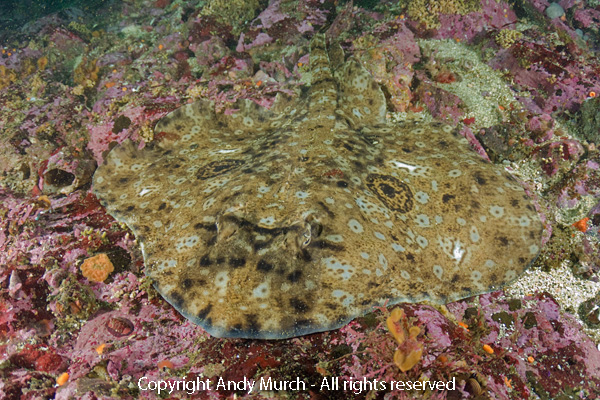
Identification: Rhomboid disc. Anterior margin of disc (from snout to free tip) weakly convex then concave. Posterior disc margin convex. Disc width and length roughly equal. snout weakly pointed. Tail less than half total length. Pelvic fins trail distinctly behind disc. Dorsum thorny. A single distinct row of thorns extends along centre line of back from behind the eyes to base of first dorsal fin and beyond first dorsal to second dorsal. Large spines visible on shoulder girdle and on edge of disc behind snout. Dorsum has extensive patterning. Dorsum mostly light brown with irregular scattered light and dark spots and blotches. Prominent ocelli with dark centre within a dark outer ring. Distinct white blotch behind ocelli may be present. A black bar sometimes present across the eyes. Dark shading may form a subtle shadowy ring around eyes and another around on lower back from level with ocelli to pelvic fins. Tail with 5 or more light rings interspersed with light brown patches (or saddles) with black centres.
Size: Maximum length 76cm. Size at birth 12-16cm
Habitat: The starry skate can be found on rocky substrates and sandy or muddly bottoms. From 18 to 732 meters. More commonly shallower than 100 meters.
Abundance and distribution: North Eastern Pacific Ocean. Starry skates can be found from the Bering Sea to northern Baja California. They are more common in California but in the last few years they have started to show up more regularly in commercial fishing operations in British Columbia.
Diet: The starry skate's diet consists mostly of small crustaceans (shrimp), cephalopods, and bony fishes.
Reproduction: Oviparous.
Vulnerability: The starry skate is assessed as 'least concern' in California by the IUCN. IUCN Quote: Total annual commercial landings data for grouped catch of Skate, unspecified for California show that landings declined from 20002005. However, this catch primarily originates from trawl fisheries, of which this species is an insignificant component. Scientific survey samples have confirmed that the species is only occasionally captured by trawls, but it is one of the most common species caught in longline surveys on rocky, un-trawlable reefs. The species may be an occasional bycatch in recreational fisheries, but fishing pressure is not considered a significant threat to it at present. There are no data to suggest that the species population has declined and it is assessed as Least Concern, given that its habitat offers it protection from fisheries.
Photographs: Barkley Sound, Vancouver Island, Canada.
Similar species: There are a number of other skates inhabiting this region. The longnose skate has a vaguely similar shape but a much more acutely pointed snout and plainer markings with smaller central ocelli. The big skate has a straighter anterior disc margin and less protruding pelvic fins.
Reaction to divers: Remains motionless (relying on camouflage) even when gently touched. May eventually bolt but it is more likely to slowly swim away and resettle.
Diving logistics: The starry skate is probably encountered by divers on deeper rocky reefs in California. The specimen in these images was found in BC but no other reports of starry skate sightings exist for this region. Please contact elasmodiver if you encounter one on a dive.
Encounters reported by divers:
Further reading: http://www.fishbase.org/Summary/SpeciesSummary.php?id=2570 http://www.iucnredlist.org/apps/redlist/details/161629/0
|
|
|
|
SHARK TRIPS |
 |
 |
 |
 |
 |
 |
 |
 |
|
MORE EXPEDITIONS |
 |
 |
 |
 |
 |
 |
 |
 |
 |
 |
 |
 |
|
|
|
SPONSORS |
 |
 |
|
ADVERTISERS |
|
|


|
|
|
ELASMO-BLOGS |
 |
 |
 |
 |
 |