|
|
|
SHARK INFO |
|
SHARK |
|
SHARK EVOLUTION |
|
|
|
SHARK DIVING |
|
SHARK DIVING 101 |
|
|
|
CONSERVATION |
|
|
|
PHOTOGRAPHY |
|
SHARK PHOTO TIPS |
|
|
|
RESOURCES |
|
|
|
WEB STUFF |
|
WHAT IS ELASMODIVER? Not just a huge collection of Shark Pictures: Elasmodiver.com contains images of sharks, skates, rays, and a few chimaera's from around the world. Elasmodiver began as a simple web based shark field guide to help divers find the best places to encounter the different species of sharks and rays that live in shallow water but it has slowly evolved into a much larger project containing information on all aspects of shark diving and shark photography. There are now more than 10,000 shark pictures and sections on shark evolution, biology, and conservation. There is a large library of reviewed shark books, a constantly updated shark taxonomy page, a monster list of shark links, and deeper in the site there are numerous articles and stories about shark encounters. Elasmodiver is now so difficult to check for updates, that new information and pictures are listed on an Elasmodiver Updates Page that can be accessed here:
|
|
_ |
BIG SKATE |
|
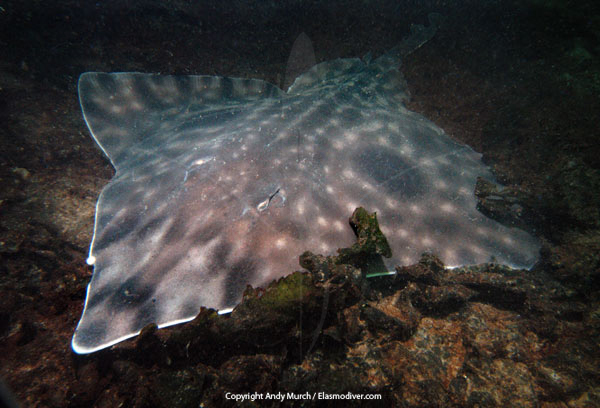
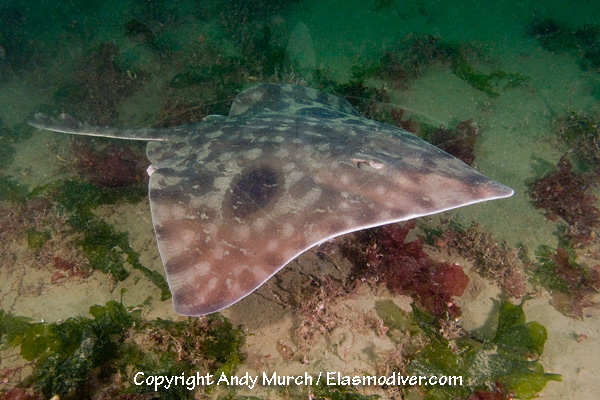
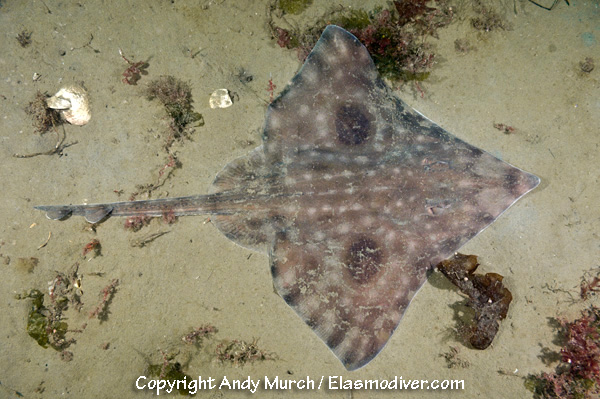
View all available Big Skate Pictures in the Shark Pictures Database Big skate, Eyed skate Latin Name: Raja binoculata Family: Rajidae Identification: Highly flattened body. Pointed, V shaped snout with mildly concave leading edges. Pectoral fin tips pointed. Row of small spines from last third of back until first dorsal fin on tail. Dorsum mottled brown to grey with smaller pale spots. Prominent dark circle (eye) on each pectoral fin with dark centres. Two dark bands curve across snout. Ventrum pale. Eyes small.
Size: Maximum length 2.4 meters but usually .9 to 1.8 meters. Habitat: Big skates are sometimes seen on low lying kelp but are generally found on sand and mud bottoms from inter-tidal to 120m. Inhabits coastal areas, estuaries, bays and continental shelves. Abundance and distribution: Behavior: Usually seen lying motionless on or under sand but occasionally seen actively foraging over soft bottoms. Reproduction: Oviparous. Lays distinctively large (20 - 25cm) egg capsules in pairs on substrate. Capsules may contain up to 8 skate embrios. Eggs hatch at around nine months.
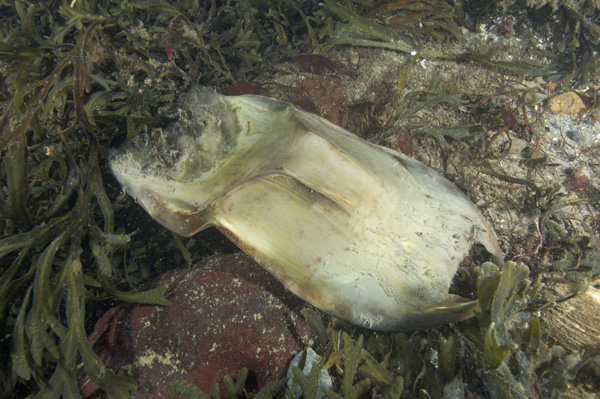
Big skate egg cases from Madrona Point, Vancouver Island. In 2006-7 there was a field of perhaps a few hundred to a thousand or more big skate egg capsules in 40 to 80 feet of water off the shoreline at Madrona point near Parksville, Vancouver Island. No animals were encountered. It has been suggested to us by Peter Bor (shark and skate egg case specialist) that the egg cases were probably deposited in August and are likely to hatch some time in November after a 9 to 15 month incubation period! The majority of the eggs were found at 45 to 60 feet. The egg capsules have now gone but the site is being monitored to ascertain if there is a multi year cycle after which the adult skates will return to the same site. Observations: Beachcomers occasionally see Big skate moving in the shallows just under the surface. Photographs: Esquimalt lagoon and Madrona Point, Vancouver Island, Canada. Similar species: Longnose skate - Raja rhina distinguished by more pointed snout and pale centers of occeli, California skate - Raja inornata, and Starry skate - Raja stellulata. Reaction to divers: Very docile. Remains motionless unless molested. Try not to hover directly above the body as this may cause it to bolt. I have fanned the silt off of one Big skate's back and it still patiently remained while I took its picture. Diving logistics: After many cold and murky dives at likely spots on Southern Vancouver Island I finally found this skate in 35ft of water at low tide off of Esquimalt lagoon about 15mins Southwest of Victoria. Park anywhere along the beach. This bay has a very shallow incline so to get to this depth from shore requires about a 20 minute kick underwater following a SW compass heading as there are no visible landmarks under water at all. Probably the best area is just beyond the low lying kelp where the bottom is clearly visible. This will be at about 35 to 45ft depending on the tide. There is almost nothing else to see in this environment except for the occasional crab and flounder. If you're lucky you may get buzzed by a seal or two. The closest place to get air is at Wilson Diving on Sooke Rd about a 5 minute drive from the lagoon. Other diving locations: Sightings submitted by Doug Graham from Redmond WA:
References: Coastal Fish Identification, California to Alaska. - Paul Humann - New World Publications. Pacific Fishes of Canada - J.L.Hart. Fisheries Research board of Canada. Ottawa 1973. Coastal Fishes of the Pacific North West - Andy Lamb and Phil Edgell - Harbour Publishing HOME
LINKS TAXONOMY
UNDER THREAT
BOOKS CONTACT
|
|
|
|
SHARK TRIPS |
 |
 |
 |
 |
 |
 |
 |
 |
|
MORE EXPEDITIONS |
 |
 |
 |
 |
 |
 |
 |
 |
 |
 |
 |
 |
|
|
|
SPONSORS |
 |
 |
|
ADVERTISERS |
|
|


|
|
|
ELASMO-BLOGS |
 |
 |
 |
 |
 |